Best Words That Rhyme With Dream — For Songwriters, Rappers & Poets
2026-07-08

Last updated: July 8, 2026
The word "dream" appears in over 120,000 song titles across genres, underscoring its universal appeal and profound lyrical potential. For songwriters, rappers, and poets seeking to capture its essence, finding the right words that rhyme with dream can elevate a simple line into an unforgettable anthem or a poignant verse. This guide explores a comprehensive collection of rhymes, from perfect matches to creative slant rhymes, helping you infuse your work with precision and flair in 2026.
Key Takeaways
-
Perfect Rhymes: Words like gleam, seem, stream, redeem, and esteem offer exact phonetic matches for "dream," providing strong, predictable rhymes.
-
Slant/Near Rhymes: Exploring words such as begin, thin, wind, or theme (when pronounced slightly differently) can add subtlety and avoid predictable rhythm.
-
Multi-Syllable Options: Incorporating multi-syllable rhymes like daydream, self-esteem, or ice cream expands lyrical complexity and creative possibilities.
-
Thematic Rhymes: Consider the emotional or conceptual meaning of "dream" (hope, aspiration, illusion) when choosing rhymes, aligning them for deeper impact.
-
Context is Key: The best rhyme depends heavily on the genre and tone of your writing, whether aiming for humor, gravitas, or a child-friendly narrative.
-
Regional Pronunciations: Be aware that slight variations in how "dream" is pronounced regionally might influence which words sound like a good rhyme.
-
Advanced Techniques: Internal rhymes, cross-rhymes, and assonance can enhance the musicality of your lines, even without strict end rhymes.
What are the best words that rhyme with dream for a poem?
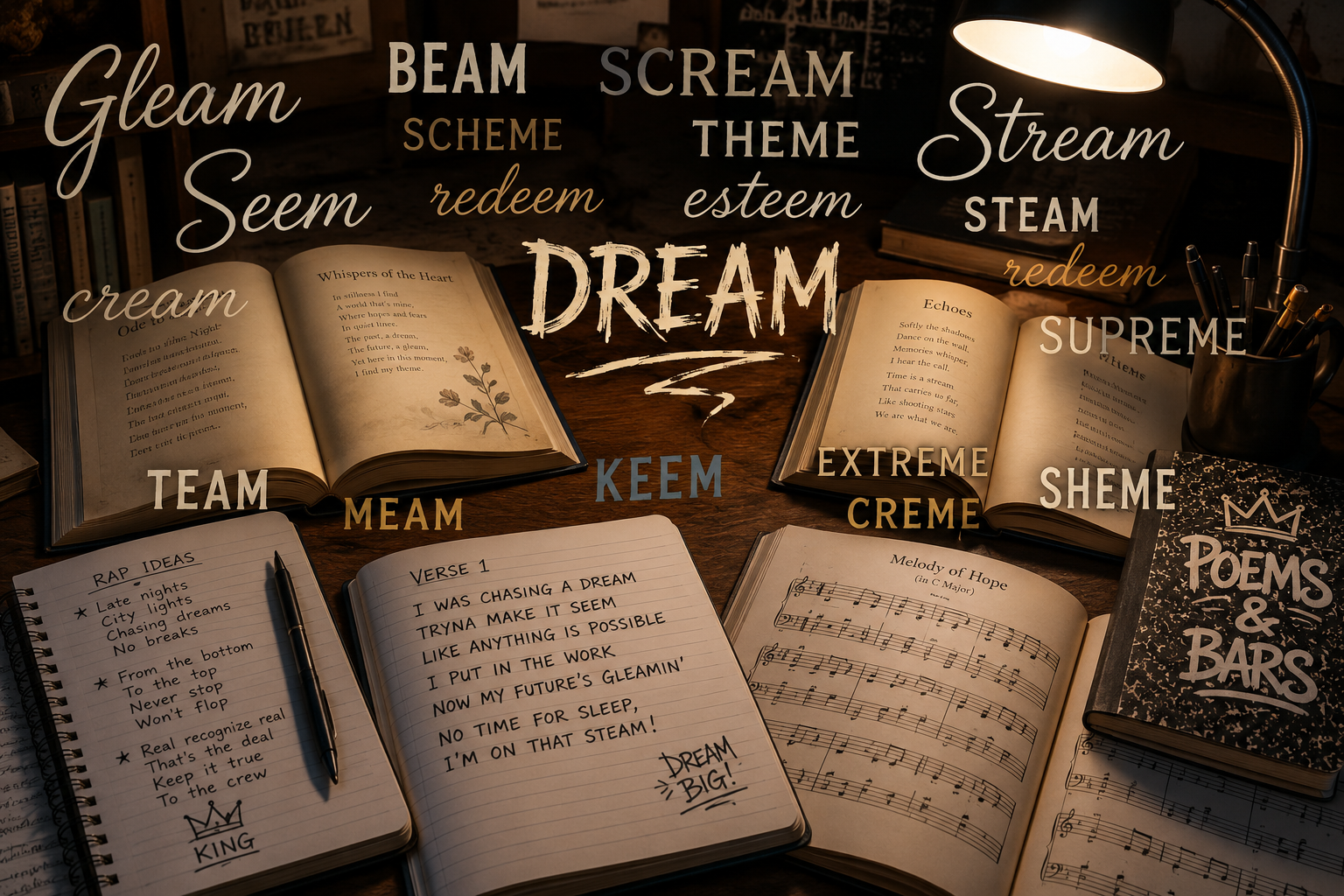
For poetry, the best words that rhyme with dream often evoke a sense of imagery, emotion, or narrative progression, ranging from perfect rhymes that create a strong sense of closure to more subtle slant rhymes that introduce nuance. Perfect rhymes like gleam, stream, seem, and redeem provide a classic, satisfying sound, while words like theme or unseen can offer a slightly softer, more contemplative echo.
When crafting a poem, the goal is often to create a specific mood or reinforce a central idea. Here's a breakdown of poetic rhymes:
-
Perfect Rhymes: These are ideal for formal poetry or when you want a strong, musical ending to a line.
-
Gleam: (e.g., "The moon's soft gleam matched my waking dream.")
-
Seem: (e.g., "Things aren't always what they seem, especially in a dream.")
-
Stream: (e.g., "A gentle stream flowing through my waking dream.")
-
Redeem: (e.g., "Only love can truly redeem a shattered dream.")
-
Esteem: (e.g., "To reach a great esteem, one must first dream.")
-
Team: (e.g., "Working as a team, we built our shared dream.")
-
Cream: (e.g., "A delicious cream conjured in a vivid dream.")
-
-
Multi-Syllable Perfect Rhymes: These add sophistication.
-
Daydream: (e.g., "Lost in a daydream, a beautiful, fleeting dream.")
-
Self-esteem: (e.g., "Building self-esteem starts with believing in your dream.")
-
-
Slant Rhymes (Near Rhymes): These offer flexibility and can prevent a poem from sounding too sing-songy. They work well when you want a hint of a rhyme without a full commitment.
-
Theme: (e.g., "The poem's central theme was about chasing a dream.")
-
Unseen: (e.g., "A beauty often unseen, much like a waking dream.")
-
Begin: (e.g., "Before you can truly begin, you must first dream.") (This is a more distant slant rhyme but can work depending on context.)
-
Consider the emotional resonance of the word. If your poem is about hope, "gleam" or "redeem" might be perfect. If it's about illusion, "seem" or "unseen" could be more fitting.
What are some funny words that rhyme with dream?

Funny words that rhyme with dream often involve unusual concepts, silly imagery, or unexpected wordplay, creating a lighthearted or comedic effect. The humor typically arises from the juxtaposition of the serious or ethereal "dream" with something mundane, ridiculous, or food-related.
Here are some options for humorous rhymes:
-
Ice cream: This is a classic for its immediate association with a sweet treat. (e.g., "I had a crazy dream I was drowning in ice cream.")
-
Steam: Can be funny when describing something absurd. (e.g., "My alarm clock made me scream, interrupting my dream about a talking teapot full of steam.")
-
Extreme: Often used for exaggerated scenarios. (e.g., "My workout was so extreme, I woke up thinking it was all a dream.")
-
Supreme: Can be used ironically or boastfully. (e.g., "I'm the rhyme scheme supreme, living out my every dream.")
-
Beam: Can be used to describe something silly happening. (e.g., "I saw a purple alien beam down in my wildest dream.")
-
Bream: (A type of fish) Can be unexpected and therefore funny. (e.g., "I had a strange dream I was fishing for a bream.")
The key to using these words for humor is the setup and context within the line or verse. A common mistake is to simply rhyme without establishing the comedic intent, which can make the rhyme feel forced rather than funny. The more unexpected the connection between "dream" and its rhyming partner, the funnier it often becomes.
What are some one-syllable words that rhyme with dream?
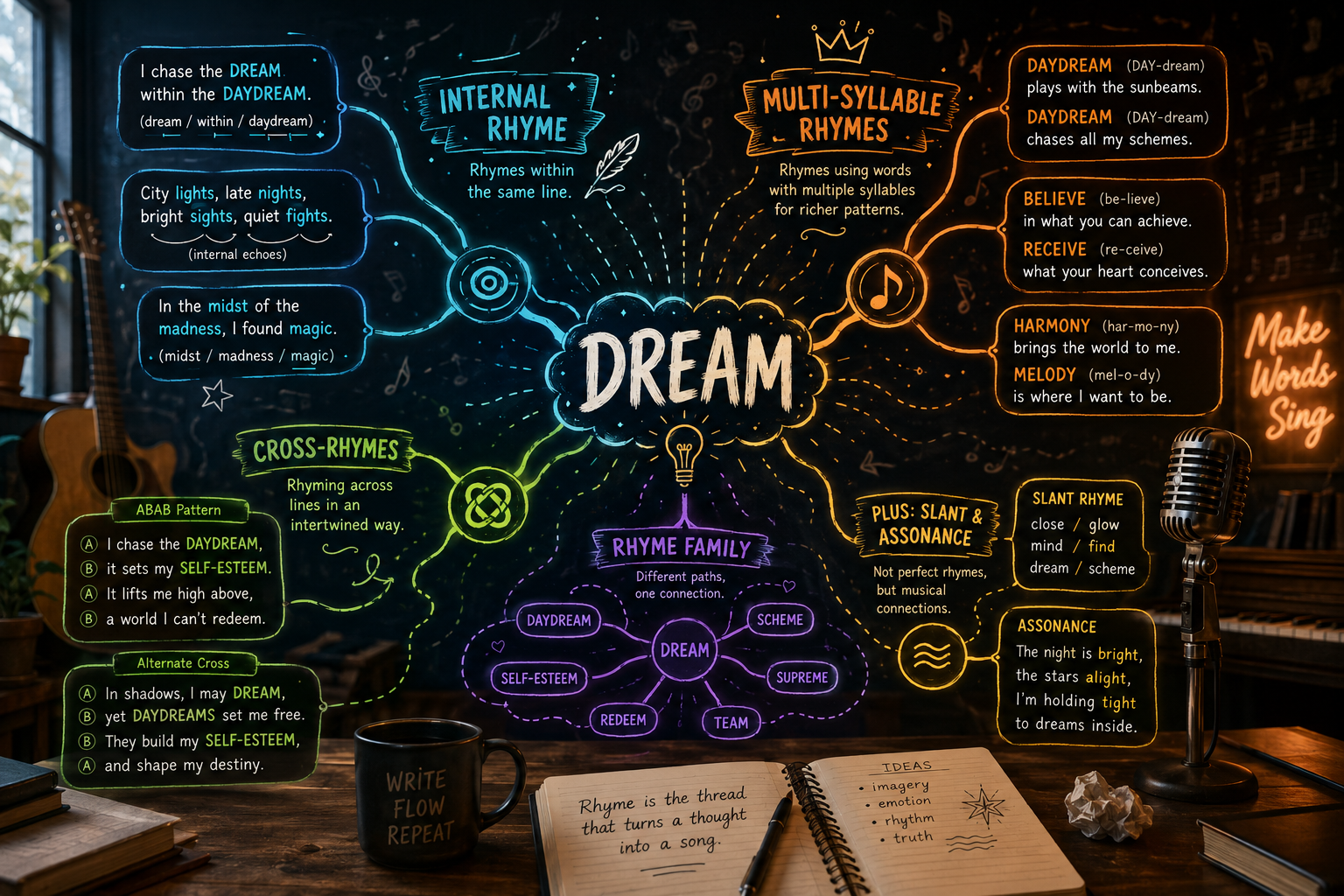
There are several strong one-syllable words that perfectly rhyme with dream, making them excellent choices for maintaining a concise rhythm and punchy delivery in songs, raps, or poems. These words typically share the long "ee" vowel sound and the "m" consonant sound at the end.
Here's a list of common and effective one-syllable perfect rhymes for "dream":
-
Beam: (e.g., "A hopeful beam in a waking dream.")
-
Cream: (e.g., "A dollop of cream in my sweetest dream.")
-
Gleam: (e.g., "A distant gleam, part of my grand dream.") You can find more rhyming words like this on our page for rhymes for gleam.
-
Seam: (e.g., "Rip apart the seam of a broken dream.")
-
Seem: (e.g., "Things aren't always what they seem in a vivid dream.")
-
Scream: (e.g., "A silent scream trapped within a bad dream.") For more options, explore our article on rhymes for scream.
-
Steam: (e.g., "Let off some steam, chasing a new dream.")
-
Scheme: (e.g., "A wicked scheme to shatter my dream.")
-
Team: (e.g., "As a team, we built this dream.")
These single-syllable rhymes are particularly useful when you need to maintain a fast pace, emphasize a simple idea, or create a strong, clean rhyme scheme. They are versatile and can fit into various lyrical contexts, from reflective poetry to high-energy rap.
What words almost rhyme with dream but not quite?
Words that almost rhyme with dream, also known as slant rhymes, near rhymes, or imperfect rhymes, share some but not all phonetic elements, offering a subtler musicality and greater flexibility than perfect rhymes. These rhymes typically match the vowel sound or the ending consonant sound, but not both, or they might have different preceding consonants.
Here are categories and examples of words that almost rhyme with dream:
-
Matching Vowel Sound (Long 'ee' sound) but different ending consonant:
-
Green: (e.g., "A vibrant green, much like a lively dream.")
-
Mean: (e.g., "What does it all mean? Is it just a dream?")
-
Seen: (e.g., "The best thing I've ever seen, straight from a dream.")
-
Queen: (e.g., "Like a majestic queen, ruling in my dream.")
-
Scene: (e.g., "A beautiful scene, like one from a dream.")
-
Clean: (e.g., "Keep your slate clean, and chase your dream.")
-
-
Matching Ending Consonant ('m' sound) but different vowel sound:
-
Gum: (e.g., "Sticky as gum, this lingering dream.") (More of a consonance, but the 'm' sound resonates).
-
Plum: (e.g., "Sweet as a plum, a memory of a dream.")
-
-
Words that share some sounds but are more distant:
-
Theme: (e.g., "The central theme of my life is this dream.") (This is a very common and effective slant rhyme.)
-
Begin: (e.g., "Let the journey begin, sparked by a single dream.")
-
Win: (e.g., "To truly win, you must first dream.")
-
Thin: (e.g., "Hope can grow thin, but never abandon your dream.")
-
Spin: (e.g., "The world starts to spin, caught in a beautiful dream.")
-
Writhe: (e.g., "Watch the serpents writhe, waking from a nightmare dream.")
-
Breath: (e.g., "Hold your breath, as you pursue your dream.")
-
Slant rhymes provide creative freedom, allowing writers to break from strict rhyming patterns while still maintaining a sense of musicality. They can add sophistication and prevent a piece from sounding overly simplistic or predictable.
Do scream and dream rhyme perfectly?
Yes, "scream" and "dream" rhyme perfectly because they share the exact same stressed vowel sound and all subsequent sounds. Both words end with the long "ee" sound followed by the "m" consonant sound ( /skriːm/ and /driːm/ ), making them ideal perfect rhymes for each other.
A perfect rhyme occurs when two words have the same stressed vowel sound and all sounds that follow it are identical, but the initial consonant sound (or sounds) must be different.
-
Scream: The stressed vowel is /iː/ (as in "bee"), followed by /m/.
-
Dream: The stressed vowel is /iː/, followed by /m/.
Since both the vowel sound and the ending consonant sound are identical, and only the initial consonant cluster changes ( 'skr' vs. 'dr' ), they are considered perfect rhymes. This makes "scream" a strong and reliable rhyming partner for "dream" in any form of writing. You can explore more options that rhyme with scream here.
What are some famous song lyrics that rhyme with dream?
Many iconic songs have utilized words that rhyme with dream to create memorable and impactful lyrics, often playing on themes of aspiration, hope, or escapism. These examples demonstrate how skilled songwriters integrate rhymes naturally into compelling narratives and melodies.
Here are a few notable examples:
-
"Imagine" by John Lennon:
"You may say I'm a dreamer / But I'm not the only one / I hope someday you'll join us / And the world will be as one."
- Analysis: While "dreamer" and "one" are not perfect rhymes with "dream," this example highlights how a close-sounding word like "dreamer" can set up a thematic rhyme, and how the concept of "dream" is used in popular music even without a direct rhyme. This uses "one" as a slant rhyme to "dreamer's" suffix.
-
"California Dreamin'" by The Mamas & The Papas:
"All the leaves are brown / And the sky is gray / I've been for a walk / On a winter's day / I'd be safe and warm / If I was in L.A. / California dreamin' on such a winter's day."
- Analysis: Here, "day" and "dreamin'" form a strong internal slant rhyme and a compelling rhythmic pattern within the chorus, even though "dreamin'" itself is the gerund of the word, it's the core concept.
-
"Sweet Dreams (Are Made of This)" by Eurythmics:
"Sweet dreams are made of this / Who am I to disagree? / I travel the world and the seven seas / Everybody's looking for something."
- Analysis: This song brilliantly uses "dreams" as its central motif without a direct end rhyme in the chorus, demonstrating that sometimes the power of the word itself, combined with strong imagery, is enough. The subsequent lines build meaning around the idea of pursuing desires, making "dream" potent on its own.
-
"Bohemian Rhapsody" by Queen:
"Is this the real life? Is this just fantasy? / Caught in a landslide, no escape from reality / Open your eyes, look up to the skies and see / I'm just a poor boy, I need no sympathy / Because I'm easy come, easy go, little high, little low / Any way the wind blows doesn't really matter to me, to me."
- Analysis: While not rhyming directly with "dream," the lyric "look up to the skies and see" is a common setup for "dream" in many songs, and "see" is a perfect rhyme for "dream." This shows how the phonetic similarity is often leveraged.
These examples illustrate that while perfect rhymes are often sought, successful songwriting also employs slant rhymes, internal rhymes, and thematic connections to make "dream" resonate.
What words rhyme with dream for rap lyrics?
For rap lyrics, words that rhyme with dream often need to be versatile, impactful, and lend themselves to complex rhyme schemes, including multi-syllable and internal rhymes, to maintain flow and lyrical dexterity. Rappers frequently use perfect rhymes for punchlines and strong cadences, but also leverage slant rhymes for greater creative freedom and intricate wordplay.
Here's a breakdown of rhymes suitable for rap, focusing on different levels of complexity:
-
One-Syllable Perfect Rhymes (for punch and directness):
-
Gleam: "My chain got that gleam, living out my dream."
-
Scheme: "Stick to the scheme, never lose sight of the dream."
-
Scream: "Make the crowd scream, chasing that championship dream." (Check out more options for rhymes for scream.)
-
Team: "Work with my team, making every big dream."
-
Cream: "Rise to the top, that's the cream, fulfilling my dream."
-
Seem: "Don't just let it seem, go out and conquer your dream."
-
Stream: "Money flow like a stream, living the lavish dream."
-
-
Multi-Syllable Perfect Rhymes (for advanced flow and wordplay):
-
Daydream: "From a dark alley daydream, to a king's lavish dream."
-
Self-esteem: "Building my self-esteem, to achieve every dream."
-
Extreme: "Pushing it to the extreme, living life like a dream."
-
Redeem: "My hustle will redeem, every broken dream." (Discover more rhymes for redeem.)
-
Supreme: "My lyrical flow is supreme, living out the hip-hop dream."
-
Undertake a scheme: (Phrase rhyme) "Gotta undertake a scheme, to accomplish the dream."
-
-
Slant Rhymes (for nuance and expanding rhyme options):
-
Green: "Stacking the green, living the American dream."
-
Mean: "You know what I mean, when I talk about the dream."
-
Seen: "The greatest story ever seen, about chasing a dream."
-
Win: "Gotta play to win, living out this dream." (See more rhymes for win.)
-
Life: "This is my life, living a waking dream." (A more distant slant, but can work in rap's flexible rhyming.)
-
Rappers often look for unexpected rhymes that still sound good, using internal rhymes (rhymes within a single line) and cross-rhymes (rhymes across lines) to maintain a dynamic flow, rather than just relying on end-of-line rhymes.
What words rhyme with dream for a children's book?
For a children's book, words that rhyme with dream should ideally be simple, positive, and easy for young readers to understand and pronounce, helping to create a lyrical and engaging narrative. The best choices often evoke bright imagery or comforting feelings, fitting the often whimsical and hopeful themes of children's literature.
Here are some excellent rhyming options for a children's book:
-
Perfect Rhymes (simple and clear):
-
Gleam: "The stars always gleam / When you follow your dream." (Adds a touch of magic.)
-
Seem: "Things may not always seem / As bright as your favorite dream." (Introduces a gentle lesson.)
-
Cream: "A scoop of ice cream / To sweeten your dream!" (Relatable and fun.)
-
Steam: "The little train puffed out steam / As it chugged toward a dream." (Action-oriented.)
-
Team: "With friends, as a team / We can make any dream!" (Emphasizes cooperation.)
-
Stream: "A playful little stream / Flowed right through my dream." (Nature imagery.)
-
-
Multi-Syllable Perfect Rhymes (slightly more complex but still clear):
-
Daydream: "A lovely bright daydream / Is just like a happy dream."
-
Ice cream: "I wish for delicious ice cream / Inside my bedtime dream!"
-
-
Slant Rhymes (use sparingly for young children, but can add variety for older kids):
-
Green: "A field of soft green / The prettiest dream I've ever seen." (Combines well with "seen.")
-
Seen: "The brightest new scene / Appears in my dream."
-
When writing for children, ensure the rhymes don't sound forced. The rhythm and story should flow naturally, and the rhyming words should enhance, rather than detract from, the narrative. Simple, repetitive structures often work best.
What are some words that rhyme with 'dream' and have a positive meaning?
When seeking words that rhyme with dream with a positive meaning, the focus is on words that evoke hope, success, brightness, or personal growth, aligning with the often aspirational nature of "dream" itself. These rhymes can reinforce themes of achievement, joy, and potential.
Here are several positive words that rhyme with "dream":
-
Perfect Rhymes:
-
Gleam: Suggests brightness, sparkle, and hope. (e.g., "A hopeful gleam in every child's dream.")
-
Redeem: Implies salvation, recovery, or making amends, often leading to a positive outcome. (e.g., "Only kindness can redeem a fading dream.") You can find more rhyming words like this on our page for rhymes for redeem.
-
Esteem: Refers to respect and admiration, often self-respect, which is a positive personal trait. (e.g., "Build your self-esteem, and reach for every dream.")
-
Team: Represents cooperation, support, and shared goals, all positive concepts. (e.g., "Together as a team, we chase our biggest dream.")
-
Beam: Can mean a ray of light or to smile radiantly, both positive. (e.g., "A joyful beam lights up my happy dream.")
-
Supreme: Denotes the highest quality or ultimate achievement. (e.g., "Aim for the supreme, accomplish your grandest dream.")
-
Cream: As in "the cream of the crop," signifying excellence. (e.g., "Rising to the top, becoming the cream, that's my ultimate dream.")
-
-
Multi-Syllable Perfect Rhymes:
-
Daydream: Often associated with pleasant thoughts and imaginative escape. (e.g., "Lost in a pleasant daydream, a beautiful dream.")
-
Self-esteem: As mentioned above, a crucial positive personal attribute.
-
These words naturally complement "dream" when the intention is to convey optimism, progress, or fulfillment, making them ideal for inspirational lyrics or verses.
What words rhyme with dream that have a negative meaning?
When looking for words that rhyme with dream that carry a negative meaning, the aim is to convey feelings of deceit, difficulty, despair, or even fear, often to create contrast or tension in a narrative. These rhymes can underscore the darker aspects of ambition, illusion, or nightmares.
Here are some negative words that rhyme with "dream":
-
Perfect Rhymes:
-
Scheme: Implies a devious or cunning plan, often with negative intent. (e.g., "A wicked scheme, to shatter every dream.")
-
Scream: Denotes fear, pain, or terror, often associated with nightmares. (e.g., "Waking with a scream, from a terrible dream.") For more similar words, see our page on rhymes for scream.
-
Seem (misleadingly): While "seem" itself is neutral, it can be used in a negative context to imply things are not as they appear, often leading to disappointment. (e.g., "Nothing is as it may seem, in this deceptive dream.")
-
Extreme (negatively): Can refer to an excessive or dangerous level. (e.g., "Pushed to the extreme, a dark and twisted dream.")
-
-
Slant Rhymes (more distant but effective for negative connotations):
-
Mean: Can imply unkindness or cruelty. (e.g., "A truly mean fate, that haunts my dream.")
-
Sin: A transgression or moral wrong. (e.g., "A bitter sin, hidden deep within this dream.")
-
Grim: Suggests a harsh or unpleasant outlook. (e.g., "The future looks grim, a hopeless dream.")
-
Disease: (Multi-syllable, more distant slant rhyme but strong negative imagery) (e.g., "Like a creeping disease, consuming every dream.")
-
Using these words strategically can add layers of conflict, sorrow, or tension, providing a counterpoint to the typically positive connotations of "dream."
How do you know if two words truly rhyme?
Two words truly rhyme, or form a "perfect rhyme," when they share the exact same stressed vowel sound and all subsequent sounds, but their initial consonant sounds are different. This precise phonetic match is what creates the satisfying resonance characteristic of a perfect rhyme.
To determine if two words truly rhyme:
-
Identify the stressed vowel sound: For words like "dream" and "scream," the stressed vowel sound is the long 'ee' sound (IPA: /iː/).
-
Check the sounds that follow the stressed vowel: In "dream," the /iː/ is followed by the /m/ sound. In "scream," the /iː/ is also followed by the /m/ sound.
-
Ensure the initial consonant sounds are different: "Dream" starts with /dr/ and "scream" starts with /skr/. Since these are different, and the rest matches, they form a perfect rhyme.
-
Example 1: Dream and Gleam
-
Stressed vowel: /iː/
-
Following sound: /m/
-
Initial consonants: /dr/ (dream) vs. /gl/ (gleam) - Different.
-
Result: Perfect Rhyme.
-
-
Example 2: Dream and Theme
-
Stressed vowel: /iː/
-
Following sound: /m/
-
Initial consonants: /dr/ (dream) vs. /θ/ (theme) - Different.
-
Result: Perfect Rhyme. (Note: Some consider 'theme' a slant rhyme depending on how strictly the initial consonant sounds are defined, but phonetically it works.)
-
-
Example 3: Dream and Green
-
Stressed vowel: /iː/
-
Following sound: /m/ (dream) vs. /n/ (green) - Different.
-
Result: Not a perfect rhyme (a slant rhyme). The ending consonants differ.
-
Understanding these phonetic components allows for a precise evaluation of rhyming pairs, crucial for maintaining poetic meter and musicality.
What's the difference between a perfect rhyme and a slant rhyme?
The core difference between a perfect rhyme and a slant rhyme lies in the degree of phonetic similarity: a perfect rhyme has identical stressed vowel and subsequent sounds, while a slant rhyme shares only some, but not all, of these phonetic elements. This distinction offers writers varying levels of musicality and flexibility in their work.
Here's a breakdown:
Perfect Rhyme (Full Rhyme)
-
Definition: Two words that have the same stressed vowel sound and all subsequent sounds are identical, but their initial consonant sounds are different.
-
Effect: Creates a strong, clear, and satisfying musicality. It often feels conclusive and predictable in a good way.
-
Examples with "dream":
-
Dream / Gleam: (/driːm/ vs. /gliːm/ - same vowel /iː/ and consonant /m/, different initial consonants /dr/ vs. /gl/)
-
Dream / Team: (/driːm/ vs. /tiːm/ - same vowel /iː/ and consonant /m/, different initial consonants /dr/ vs. /t/)
-
Dream / Seem: (/driːm/ vs. /siːm/ - same vowel /iː/ and consonant /m/, different initial consonants /dr/ vs. /s/)
-
Slant Rhyme (Near Rhyme, Half Rhyme, Imperfect Rhyme)
-
Definition: Two words that share either the same vowel sound OR the same ending consonant sound, but not both. The initial consonant sounds are typically different.
-
Effect: Creates a subtler, less predictable musicality. It can add sophistication, prevent a monotonous rhythm, or offer more flexibility when a perfect rhyme is hard to find. It often feels like a "near miss" or an echo.
-
Examples with "dream":
-
Dream / Green: (/driːm/ vs. /griːn/ - same vowel /iː/, but different ending consonants /m/ vs. /n/)
-
Dream / Time: (/driːm/ vs. /taɪm/ - shares the ending consonant /m/, but different vowel /iː/ vs. /aɪ/)
-
Dream / Win: (/driːm/ vs. /wɪn/ - more distant, only shares the 'n' sound from the 'm' slightly through nasalization, different vowel)
-
Dream / Breath: (/driːm/ vs. /brɛθ/ - very distant, might be considered assonance or consonance if any sound matches, but not a strong slant rhyme).
-
Choosing between perfect and slant rhymes depends on the desired effect. Perfect rhymes provide clarity and traditional musicality, while slant rhymes offer artistic freedom and can infuse a piece with modern or understated rhythm.
What are some advanced rhyming techniques to use with dream?
Advanced rhyming techniques involving the word "dream" go beyond simple end rhymes, incorporating multi-syllable structures, internal rhymes, and wordplay to create richer, more complex lyrical patterns. These methods enhance the musicality and intellectual depth of a piece, making the writing more engaging for the audience.
Here are some advanced techniques:
-
Multi-Syllable Rhymes: Using words that have more than one syllable, where the stressed syllable rhymes with "dream." This adds complexity and sophistication.
-
Examples: Daydream, self-esteem, extreme, self-redeem, ice cream, supreme, stream-line (verb).
-
Usage: "Lost in a pleasant daydream, pursuing an impossible dream." or "With utmost self-esteem, I declared my life's dream."
-
-
Internal Rhyme: Rhyming "dream" (or a word that rhymes with it) with another word within the same line of poetry or lyric.
-
Example: "The gleam in his eye reflected a future dream."
-
Example: "A silent scream, a waking dream, it's more than it would seem."
-
-
Cross Rhyme (Interlaced Rhyme): Where words in the middle of one line rhyme with words in the middle of another, or the end of one line rhymes with the middle of another.
- Example:
"The gentle stream flowed on, a quiet daydream was his.**
He nurtured his grand dream, hoping it would surely gleam."
(Here, "stream" rhymes internally with "daydream," and "dream" at the end of the second line rhymes with "gleam" at its end.)
- Example:
-
Assonance: Repeating the vowel sound of "dream" (the long 'ee' sound) with different ending consonants. This creates a subtle, melodic connection without a full rhyme.
-
Examples: See, believe, free, keep, deep, leave.
-
Usage: "I want to see what my future can be, chasing my lifelong dream." (Here, 'see' and 'be' use the /iː/ sound.)
-
-
Consonance: Repeating the consonant sound of "dream" (the /m/ sound) with different vowel sounds. This creates a percussive or textured connection.
-
Examples: Come, home, sum, balm, drum, whim.
-
Usage: "The thoughts would come and come, escaping my dream."
-
-
Compound Rhymes/Phrase Rhymes: Rhyming "dream" with a multi-word phrase that collectively matches the sound.
-
Examples: "A life's theme," "a simple scheme," "a sweet ice cream."
-
Usage: "My greatest aspiration, my life's theme, is to live out this beautiful dream."
-
-
Reverse Rhyme (Feminine/Masculine Rhyme Variation): While "dream" is a masculine rhyme (ending on a stressed syllable), you can play with feminine rhymes where the stressed syllable is followed by an unstressed one. While not a direct rhyme for "dream," you can use it in conjunction with multi-syllable words.
- Example: If you rhyme "daydreaming" with "beaming", the "eaming" sound connects, providing a different rhythmic feel.
Employing these techniques can add significant depth and artistry to your writing, making "dream" not just a rhyming word, but a focal point for linguistic creativity.
Are there any regional pronunciations of dream that change its rhymes?
While "dream" is largely consistent in its pronunciation across standard English dialects, minor regional variations in vowel sounds can subtly affect what words are considered perfect rhymes, especially in non-rhotic accents or those with different 'ee' sounds. However, for most common perfect rhymes like gleam or scream, the match remains strong.
-
Standard Pronunciation: In most General American and British English accents, "dream" is pronounced with the long "ee" vowel sound (IPA: /driːm/).
-
Vowel Shifts: In some very specific regional accents, particularly older or highly localized ones, the 'ee' vowel sound might be slightly diphthongized or shifted, potentially making some perfect rhymes sound less precise. For instance, if an accent slightly shortens or alters the "ee" sound, a word like "gleam" might not feel as exact a match to a speaker of that accent compared to a standard pronunciation.
-
Non-Rhotic Accents: This is less about "dream" itself and more about how surrounding words are pronounced. For example, in non-rhotic accents (like many in the UK, Australia, and parts of the US), the 'r' sound at the end of a syllable or before a consonant is often dropped. This wouldn't affect "dream" as the 'r' is at the beginning, but it's important for other rhyming words that might include an 'r'.
-
Specific Examples:
-
Irish English: While usually close to standard, some older Irish accents might have a slightly different "ee" sound that makes certain rhymes feel less "perfect" than in General American.
-
Southern US English: Some Southern US accents might subtly lengthen or alter vowels, but "dream" typically retains its strong /iːm/ sound, so words like gleam or scream still largely function as perfect rhymes.
-
For the vast majority of songwriters, rappers, and poets working in English, the standard pronunciation of "dream" ( /driːm/ ) is stable enough that the common perfect rhymes (gleam, seem, stream, redeem, esteem, team, cream, scream) will work universally. If you're writing for a very specific regional audience with a distinct dialect, it's always wise to listen to how native speakers pronounce words to ensure the rhyme hits just right.
Conclusion
Mastering the art of rhyming with "dream" is an invaluable skill for any songwriter, rapper, or poet, offering a rich palette of sounds and meanings. From the crisp precision of perfect rhymes like gleam and redeem to the subtle musicality of slant rhymes such as green or theme, the choices you make can profoundly shape your narrative and emotional impact.
In 2026, as creative boundaries continue to expand, embracing advanced techniques like multi-syllable and internal rhymes will further elevate your craft, adding depth and sophistication to your verses. Remember that the best rhyme isn't just about sound; it's about context, intention, and how effectively it serves the overarching message of your work. By exploring these diverse options and understanding the nuances between perfect and imperfect rhymes, you can ensure your "dream" lines not only resonate but truly soar.
Related Reading:
Find the perfect rhyme for your next song
Try RhymeItNow →