Best Words That Rhyme With Night — For Songwriters & Rappers
2026-06-29
Best Words That Rhyme With Night — For Songwriters & Rappers
Last updated: June 29, 2026
When crafting compelling lyrics, a strong understanding of words that rhyme with night is essential for songwriters, rappers, and poets alike, as it offers a versatile sonic foundation for everything from romantic ballads to hard-hitting rap verses. The common "ight" sound provides numerous perfect and slant rhyme options, allowing for creative flexibility across diverse musical genres and poetic forms.
Key Takeaways
-
Perfect Rhymes are Abundant: Words like "light," "might," "fight," "right," and "sight" offer direct and strong phonetic matches.
-
Two-Syllable Options Enhance Complexity: "Moonlight," "starlight," "twilight," and "spotlight" add depth and imagery.
-
Slant Rhymes Broaden Possibilities: Words like "time," "mine," or "life" can be used for a less rigid, more nuanced sound.
-
Emotional Range is Vast: Rhymes for "night" can convey romance ("delight"), darkness ("fright"), ambition ("height"), or clarity ("bright").
-
Context is King: The best rhyme depends on the song's theme, mood, and the desired rhythmic flow.
-
Avoid Clichés Creatively: While common, popular rhymes can be refreshed through unexpected imagery or clever phrasing.
-
Listen to the Flow: Always read lyrics aloud to ensure the chosen rhymes sound natural and impactful within the rhythm and melody.
-
Foreign Sounds Offer Freshness: Exploring words from other languages that share a similar phonetic ending can introduce unique textures.
What Are Some Easy Words That Rhyme With Night?
Easy words that rhyme with night are typically single-syllable words ending with the "-ight" sound, providing clear and straightforward phonetic matches for quick and effective lyrical construction. These words are often the first to come to mind and form the backbone of many popular songs and poems due to their simplicity and strong sonic connection.
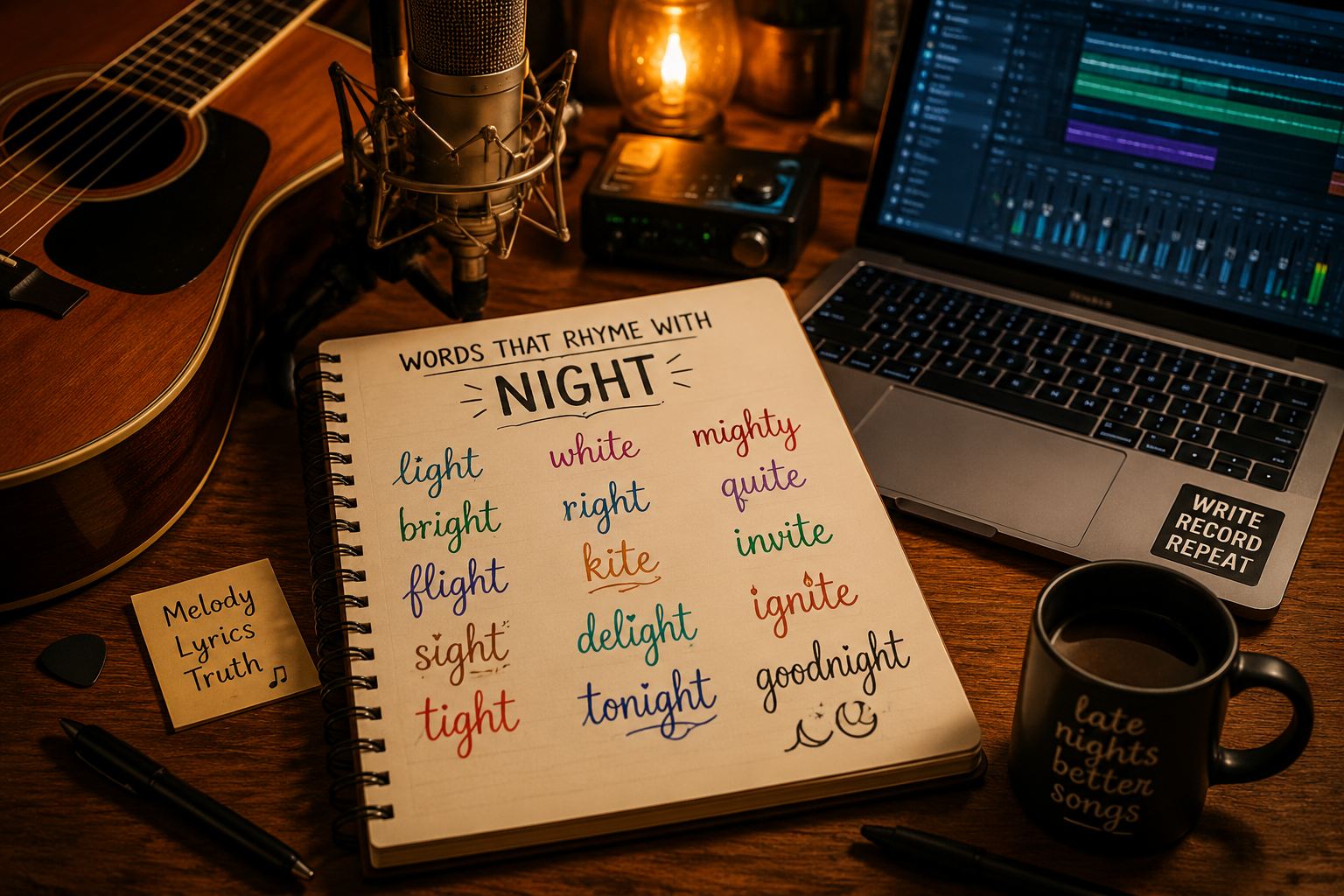
These common perfect rhymes are invaluable for their directness:
-
Light: Often used for brightness, understanding, or a lack of weight.
- Example: "In the darkness of the night, you bring the light."
-
Might: Conveys power, possibility, or strength.
- Example: "We'll stand and fight with all our might."
-
Fight: Implies conflict, struggle, or determination.
- Example: "Every night, I fight these demons in my head."
-
Right: Denotes correctness, direction, or a sense of justice.
- Example: "I know what's right, even in the darkest night."
-
Sight: Refers to vision, observation, or a spectacle.
- Example: "What a beautiful sight under the moonlit night."
-
Bright: Describes vividness, intelligence, or optimism.
- Example: "The city lights shine bright through the long night."
-
White: A color often associated with purity, snow, or emptiness.
- Example: "Snow falls white on Christmas night."
-
Tight: Can mean secure, close-fitting, or even intoxicated in slang.
- Example: "The crew was tight all through the night."
-
Slight: Suggests a small amount, a delicate build, or to disrespect.
- Example: "There's not a slight chance you'll win this fight tonight."
-
Plaight (Archaic for "pleat" or "fold," less common in modern usage but still a perfect rhyme).
When choosing an easy rhyme, consider its common associations and how it fits the overall message of your lyrics. For instance, using "light" often evokes hope, while "fight" immediately brings conflict to mind.
What are Some Good Words That Rhyme with 'Night' for a Rap Song?
For rap songs, the best words that rhyme with night often combine perfect phonetic matches with slang, aggressive imagery, or concepts of power, struggle, and urban life. Rappers prioritize strong, impactful rhymes that drive the rhythm and deliver a clear message, often incorporating multi-syllabic rhymes for intricate flow.
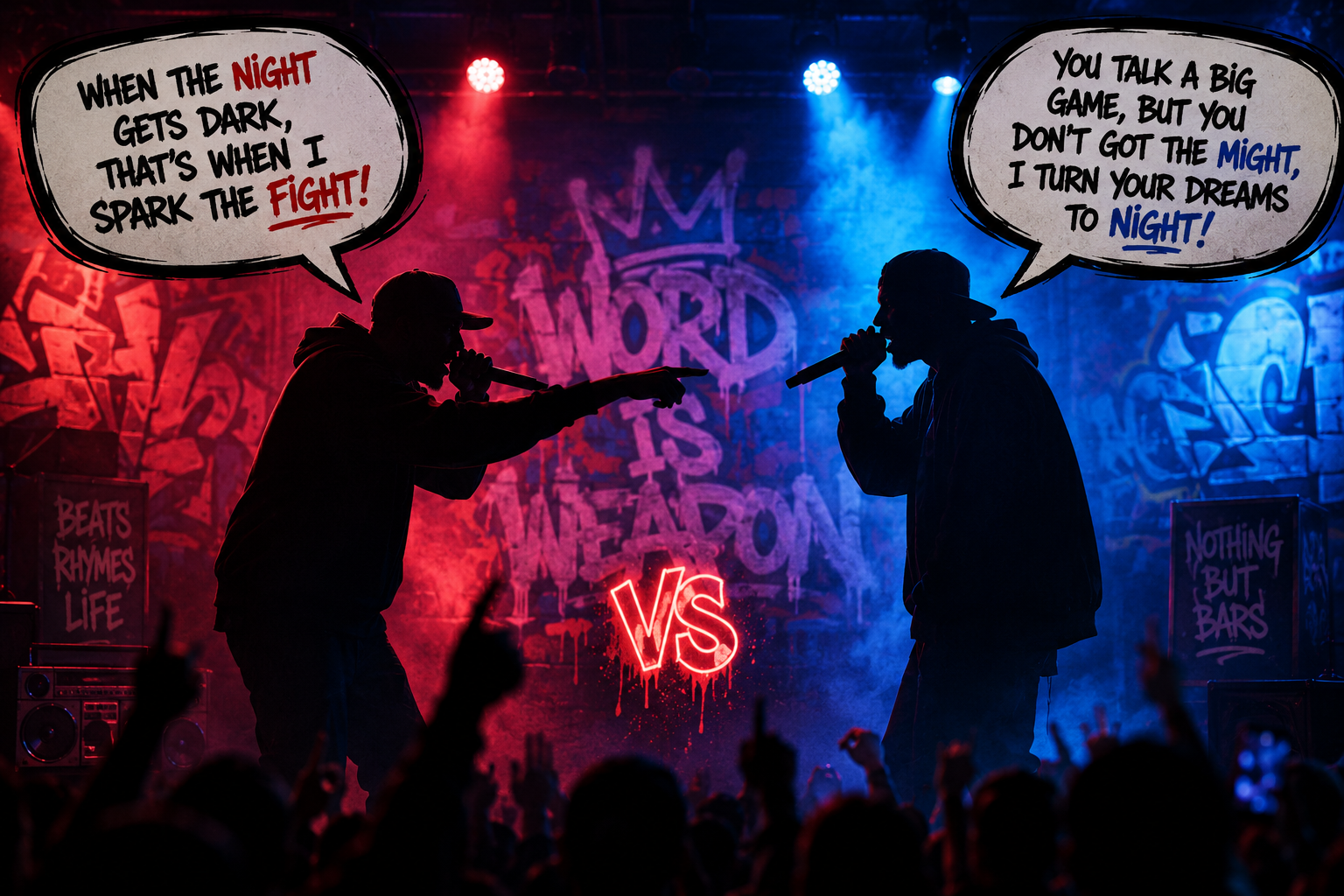
Here’s a breakdown of common and effective rhymes for rap, categorized by their typical usage:
Common & Direct Rhymes
These are staples in rap for their clear sound and versatility.
-
Fight: Essential for themes of conflict, struggle, or dominance.
- Example: "Out on the streets, another Friday night, gotta fight to earn my stripes."
-
Right: Used for justice, correctness, or asserting one's position.
- Example: "Know I'm always right, even in the spotlight, movin' through the night."
-
Light: Can refer to illumination, awareness, or getting high.
- Example: "Spark it up, then take flight, feelin' too light under the city night."
-
Might: Expresses power, potential, or force.
- Example: "Got the lyrical might, shinin' super bright, movin' all through the night."
-
Tight: Often used to describe something cool, secure, or a close-knit group.
- Example: "My crew's tight, we grind all night, till the morning light."
-
Bright: For success, intelligence, or shining.
- Example: "Future looks bright, stayin' up all night, puttin' words to the beat right."
Edgy & Aggressive Rhymes
These words add a harder edge, perfect for battle raps or darker themes.
-
Bite: Can imply aggression, taking a piece, or criticism.
- Example: "Got the hunger, ready to bite, predator in the night."
-
Smite: (More formal, but effective for strong, decisive action) To strike with a heavy blow.
- Example: "Enemies I smite, vanish in the night, ain't no time for fear or fright."
-
Plight: Refers to a difficult or unfortunate situation.
- Example: "Understand the plight, survivin' every night, prayin' for the light."
-
Slight: Can refer to disrespect or a small amount.
- Example: "Don't you dare slight my hustle, I work all night, feel the muscle."
Multi-Syllable & Complex Rhymes
For a more advanced flow, incorporating two-syllable or compound words can elevate rap lyrics.
For more inspiration on complex rhymes, check out rhymes for "midnight" and rhymes for "tonight".
-
Moonlight: Adds atmospheric imagery.
- Example: "Underneath the moonlight, we gather and unite, preparing for the fight."
-
Spotlight: Relates to fame, attention, or performance.
- Example: "Chasin' the spotlight, workin' day and night, till my name is burned bright."
-
Starlight: Another atmospheric element, often symbolizing dreams or distance.
- Example: "Wish upon the starlight, hopin' for the right moment to ignite."
-
Twilight: Evokes a transitional, often mysterious time.
- Example: "From twilight till the sun's first light, we hustle hard, day and night."
-
Ignite: To set on fire, metaphorically to inspire or start something.
- Example: "My words ignite the stage, changin' the whole game in one night."
-
Dynamite: An explosive, symbolizing impact or power.
- Example: "My flow's dynamite, blowin' up the night, everything I write hits just right."
-
Overnight: Refers to something happening quickly or during the night.
- Example: "Built this empire overnight, yeah, that's my kinda might, shine so bright."
When selecting words that rhyme with night for rap, consider not just the sound, but also the word's cultural weight and how it contributes to the narrative and swagger of your track.
What Are Some Two-Syllable Words That Rhyme With Night?
Two-syllable words that rhyme with night expand lyrical options beyond simple perfect rhymes, allowing for more descriptive imagery and rhythmic complexity in songwriting and poetry. These words often combine a preceding syllable with the familiar "-ight" sound, creating richer textures and deeper meaning.
Here are several excellent two-syllable options:
-
Moonlight: Pertaining to the light of the moon; widely used for romantic or serene settings.
- Example: "Beneath the soft moonlight, we danced away the night."
-
Starlight: The light from stars; often evokes dreams, wishes, or vastness.
- Example: "Guided by the starlight, we found our way through the night."
-
Twilight: The soft, diffused light from the sky when the sun is below the horizon, either after sunset or before sunrise; a magical, transitional time.
- Example: "From fading twilight to the deepest night, the city comes alive, shining bright."
-
Spotlight: A strong beam of light directed at a particular place or person, especially on a stage; often associated with fame or attention.
- Example: "Caught in the spotlight, I embraced the night."
-
Daylight: The natural light of the day; often contrasted with night.
- Example: "We worked through the daylight and into the night."
-
Flashlight: A portable battery-operated electric lamp.
- Example: "With just a flashlight, we explored the dark night."
-
Headlight: A powerful light at the front of a vehicle.
- Example: "The truck's headlight pierced through the foggy night."
-
Gaslight: A jet of burning gas used for illumination; also, to manipulate someone by psychological means.
-
Example (literal): "Beneath the old gaslight, we reminisced about the night."
-
Example (figurative): "Don't let them gaslight you into thinking you're not right."
-
-
Limelight: The focus of public attention; often implies fame.
- Example: "He craves the limelight, living every night like a star."
-
Overnight: During the course of a night; also, suddenly or very quickly.
- Example: "Success didn't come overnight, but after many a long night."
-
Upright: Positioned vertically; also, honorable or respectable.
- Example: "He stood upright, facing the challenges of the night."
-
Insight: The capacity to gain an accurate and deep understanding of someone or something.
- Example: "A sudden insight struck me late at night."
-
Delight: Great pleasure or satisfaction.
- Example: "Their laughter brought delight throughout the festive night."
-
Polite: Showing respectful and considerate behavior.
- Example: "Even in the rowdiest night, she remained ever so polite."
When incorporating two-syllable rhymes, consider how the longer word impacts the rhythm and syllable count of your lines. They can create a more sophisticated or vivid lyrical image than single-syllable rhymes.
What Are Some Slant Rhymes for Night?
Slant rhymes (also known as near rhymes, half rhymes, or imperfect rhymes) for "night" involve words that share either consonant sounds or vowel sounds, but not both, providing a less rigid and more subtle poetic connection. These rhymes offer songwriters and rappers greater flexibility, preventing a predictable "Dr. Seuss" feel and allowing for a broader range of vocabulary and emotional nuance.
Here are some effective slant rhymes for "night," categorized by shared sound:
Shared Consonant Sound (Ending T or GHT Sound)
These words often end with a hard 't' sound or a similar 'ght' feeling.
-
Net: (Vowel sound differs, but ends with a 't' sound)
- Example: "Caught in a dark net, dreading the coming night."
-
Debt: (Similar to 'net')
- Example: "Paying off a heavy debt, before the fall of night."
-
Met: (Similar to 'net')
- Example: "The eyes of someone I once met, under a moonless night."
-
Heart: (Ends with a 't' sound)
- Example: "A heavy heart, enduring the lonely night."
-
Art: (Similar to 'heart')
- Example: "Creating art throughout the long night."
-
Late: (Similar 't' ending, different vowel)
- Example: "It's getting late, as darkness claims the night."
-
Great: (Similar to 'late')
- Example: "A truly great idea struck me last night."
-
Trust: (Shares the 't' sound, but vowel is different)
- Example: "Hard to trust in the shadows of the night."
-
Must: (Similar to 'trust')
- Example: "Some things one must face alone at night."
-
Thought: (Shares the 'ght' spelling and 't' sound, but vowel is different)
- Example: "Lost in deep thought during the silent night."
-
Caught: (Similar to 'thought')
- Example: "He was caught unaware by the sudden night."
-
Wrought: (Similar to 'thought')
- Example: "Destiny was wrought under that starless night."
Shared Vowel Sound (I or Long I Sound)
These words share the vowel sound of "night" but have different ending consonants.
-
Time: (Shares the long 'i' sound)
- Example: "Lost track of time, wandering through the night."
-
Mine: (Similar to 'time')
- Example: "This feeling is mine, in the depths of the night."
-
Fine: (Similar to 'time')
- Example: "Everything feels fine, beneath the silver night."
-
Line: (Similar to 'time')
- Example: "Cross the line, embrace the coming night."
-
Sky: (Shares the long 'i' sound)
- Example: "Gazing at the endless sky, a clear and starry night."
-
Eye: (Similar to 'sky')
- Example: "A watchful eye guarding through the night."
-
High: (Similar to 'sky')
- Example: "Spirits flying high, celebrating the night."
-
Die: (Similar to 'sky', can be used for dramatic effect)
- Example: "Let worries die with the fading night."
-
Life: (Shares the long 'i' sound, but ends with 'f')
- Example: "This is my life, living every night as if it's the last."
-
Wife: (Similar to 'life')
- Example: "Thinking of my wife, as I journey through the night."
-
Cry: (Shares the long 'i' sound)
- Example: "I heard a lonely cry in the middle of the night." rhymes for "cry"
Using Slant Rhymes Effectively
-
Subtlety: Slant rhymes offer a more sophisticated sound, allowing for complex emotional resonance without sounding forced.
-
Vocabulary Expansion: They free you from the limitations of perfect rhymes, enabling a wider range of words and ideas.
-
Emotional Impact: A carefully chosen slant rhyme can create a feeling of unease, longing, or introspection that a perfect rhyme might not. For example, rhyming "night" with "pain" (a slant rhyme on the long 'a' sound followed by 'n') can create a powerful emotional connection, as explored in rhymes for "pain".
-
Rhythmic Flow: In rap, slant rhymes are crucial for maintaining intricate rhyme schemes and intricate flows, as they allow more choices without breaking the rhythm.
When using slant rhymes, always test them by reading them aloud to ensure they feel natural and contribute to the desired effect, rather than just sounding "off."
What Are Some Common Rhyming Mistakes for 'Night'?
Common rhyming mistakes for 'night' often stem from forcing a rhyme that isn't phonetically close enough, relying too heavily on cliché pairings, or choosing words that disrupt the song's tone or meaning. While flexibility with slant rhymes is encouraged, a weak or irrelevant rhyme can jar the listener and detract from the lyrical quality.
Here are specific pitfalls to avoid:
-
Forcing a Near Rhyme That Doesn't Quite Work:
-
Mistake: Using words that share only one sound element, but not enough to create a discernible connection. For example, rhyming "night" with "come" or "love." While "love" might feel like it could rhyme due to emotional context, the vowel and consonant sounds are too dissimilar.
-
Better Approach: If you want a softer connection, opt for established slant rhymes like "time," "mine," or "heart" that at least share a strong vowel or consonant sound.
-
-
Over-Reliance on Clichéd Pairings:
-
Mistake: Constantly rhyming "night" with "light" or "fight" without fresh imagery or context. While these are perfect rhymes, their overuse can make lyrics sound uninspired or predictable.
-
Better Approach: Even with common rhymes, pair them with unexpected descriptions or delve into less common meanings. For instance, instead of "The stars are bright in the night," try "The neon glow burns bright, painting the city's night." Or explore two-syllable alternatives like "moonlight" or "twilight."
-
-
Choosing a Rhyme That Breaks the Tone or Meaning:
-
Mistake: Selecting a word purely for its rhyme, even if its connotation clashes with the rest of the lyric. For example, rhyming "romantic night" with "blight" (a disease or curse).
-
Better Approach: Always consider the semantic field of your words. If you're writing a love song, lean towards words like "delight" or "bright." If it's a dark narrative, "plight" or "fright" might fit better.
-
-
Inconsistent Rhyme Schemes:
-
Mistake: Starting with perfect rhymes for "night" but then suddenly switching to very distant slant rhymes or no rhyme at all in a way that feels unintentional.
-
Better Approach: Decide early whether you're aiming for perfect rhymes, consistent slant rhymes, or a more free-verse approach. If using slant rhymes, try to maintain a similar degree of "slant" throughout a verse or section.
-
-
Prioritizing Rhyme Over Natural Phrasing:
-
Mistake: Twisting sentence structure or using awkward phrasing just to hit a rhyme.
-
Better Approach: Always prioritize natural language and clear communication. If a rhyme feels forced, it’s better to rephrase the line, use a slant rhyme, or even opt for an unrhymed line if it serves the song better. The flow of the language is often more important than a perfect rhyme. For help with choosing words that fit the flow, consider exploring synonyms for concepts like "desire" (rhymes for "desire") or "voice" (rhymes for "voice") to find options that also rhyme.
-
By being mindful of these common errors, songwriters and rappers can elevate their craft, creating lyrics that are both technically proficient and emotionally resonant.
What Are Some Famous Song Lyrics That Rhyme With Night?
Numerous famous song lyrics feature words that rhyme with night, illustrating how effectively artists across genres use this versatile sound for themes ranging from love and yearning to rebellion and self-discovery. These examples often demonstrate clever word choice and impactful emotional resonance.
Here are some iconic examples:
-
"A Hard Day's Night" by The Beatles (1964)
-
"It's been a hard day's night, and I've been working like a dog / It's been a hard day's night, I should be sleeping like a log."
-
Rhymes: night / log (slant rhyme, sharing the short 'o' vowel sound, but different ending consonants; the connection is strong enough to work musically).
-
-
"Night Moves" by Bob Seger (1976)
-
"Working on our night moves / Trying to make some first time feel good light moves."
-
Rhymes: night / light (perfect rhyme). This song also masterfully uses "moves" as a slant rhyme for "night" and "light" due to the shared 's' sound at the end and the preceding similar vowel.
-
-
"Stairway to Heaven" by Led Zeppelin (1971)
- "And a new day will dawn for those who stand long / And the forests will echo with laughter." (This doesn't directly rhyme with "night" but illustrates a common lyrical pattern in songs where "night" features prominently in themes of transition and spiritual journey, often contrasting with "light" or "day.")
-
"Bohemian Rhapsody" by Queen (1975)
-
"Thunderbolts and lightning, very, very frightening me / (Galileo) Galileo, (Galileo) Galileo, Galileo figaro / Magnifico-o-o-o."
-
Rhymes: While not a direct rhyme for "night," the word "frightening" (containing the 'ight' sound) appears in close proximity to impactful lyrical moments, demonstrating how the sound can be integrated, even without a perfect rhyme, to evoke specific emotions like fear or urgency.
-
-
"Blinding Lights" by The Weeknd (2019)
-
"I'm blinded by the lights / No, I can't sleep until I feel your touch."
-
Rhymes: lights / night (implied, as "lights" is a plural of a perfect rhyme). The song often plays on the contrast between overwhelming urban lights and the feeling of loss or longing through the night.
-
-
"Empire State of Mind" by Jay-Z ft. Alicia Keys (2009)
-
"New York, concrete jungle where dreams are made of / There's nothing you can't do / Now you're in New York / These streets will make you feel brand new / Big lights will inspire you."
-
Rhymes: While "night" isn't explicitly rhymed with, the song extensively uses "lights" and "bright" to describe the city, particularly at night, and effectively captures the energy that comes alive in the city after dark. This illustrates how related concepts and perfect rhymes can create a consistent thematic soundscape, like in rhymes for "bright".
-
-
"One More Night" by Maroon 5 (2012)
-
"So I'll ask you, 'Is this our last goodnight?' / Or will I see you in the morning light?"
-
Rhymes: night / light (perfect rhyme, used for longing and uncertainty).
-
-
"Last Friday Night (T.G.I.F.)" by Katy Perry (2011)
-
"Last Friday night, yeah we danced on tabletops / And took too many shots, think we went a little hard."
-
Rhymes: night / hard (slant rhyme, sharing the 't' sound but different vowels). This shows how pop music can effectively use less-than-perfect rhymes for a looser, more conversational feel.
-
These examples highlight how versatile "night" and its rhymes are, fitting into everything from classic rock anthems to modern pop and rap, always serving to amplify the song's narrative and emotional core.
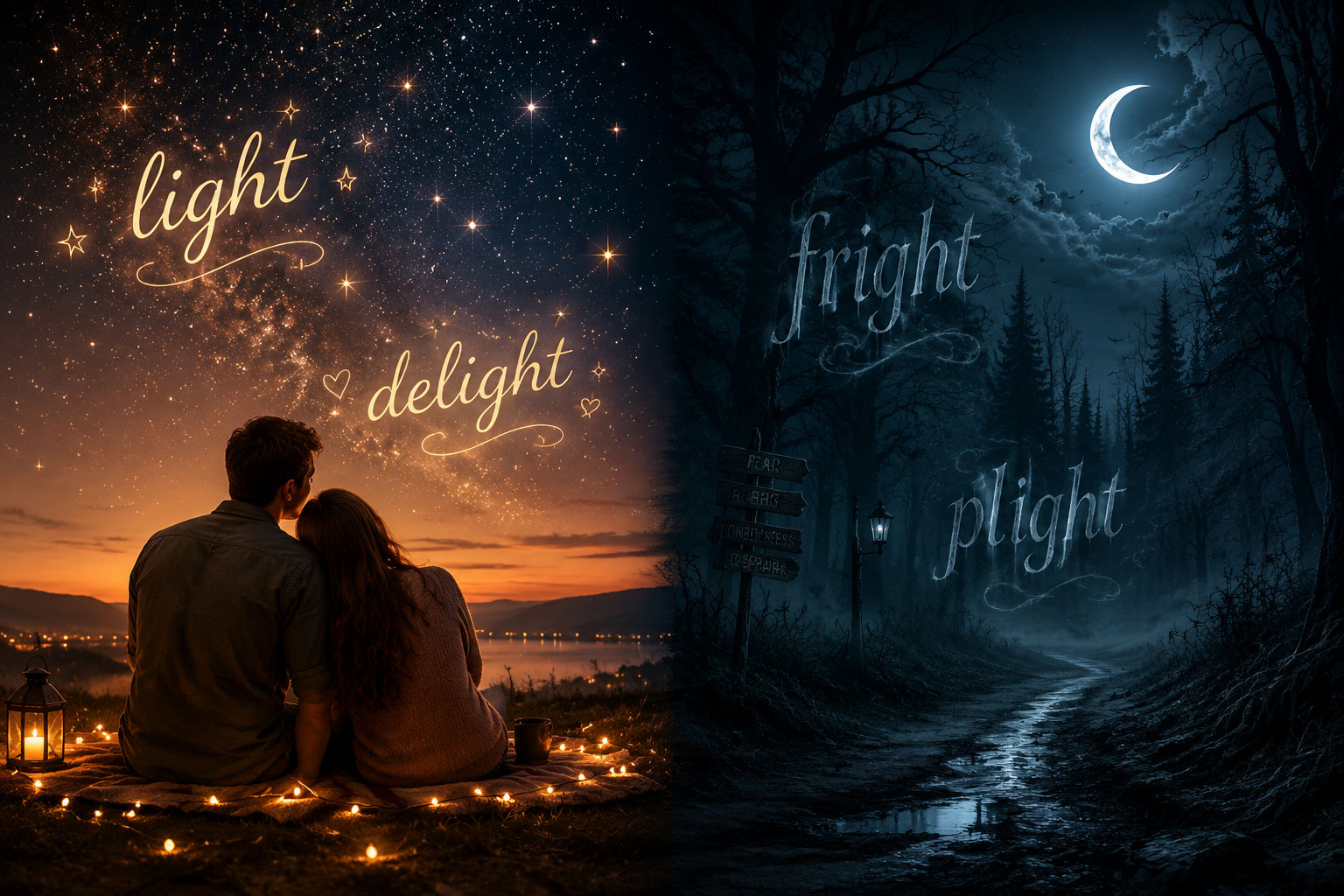
What Rhymes With Night That Sounds Romantic?
Words that rhyme with night and evoke a romantic feeling often refer to beauty, pleasure, or intimate connections, enhancing themes of love, longing, and serene moments shared with a loved one. The inherent imagery of the night itself—stars, moon, quiet intimacy—lends itself perfectly to such emotional resonance.
Here are some romantic words that rhyme with night:
-
Delight: Great pleasure, satisfaction, or joy.
- Example: "Every moment with you brings pure delight, under the velvet night."
-
Light: While common, "light" can be incredibly romantic when referring to a partner's presence, hope, or guiding influence.
- Example: "You are my guiding light, shining through the darkest night."
-
Bright: Suggests radiance, happiness, or a promising future.
- Example: "Our love burns so bright, illuminating every night."
-
Moonlight: Evokes serenity, beauty, and intimate settings.
- Example: "Dancing beneath the soft moonlight, making memories in the quiet night."
-
Starlight: Connotes dreams, wishes, and timeless affection.
- Example: "Whispering wishes to the starlight, holding you close all through the night."
-
Insight: When referring to a deep understanding of a partner.
- Example: "Your gentle words provide such insight, making sense of my heart's long night."
-
Unite: To come together, symbolizing a bond or togetherness.
- Example: "Our hearts truly unite, in the magic of this tranquil night."
-
Invite: Can suggest a romantic invitation or welcoming presence.
- Example: "I long to invite you into my world, where every night feels just right."
-
Sweetest Sigh: (A phrase that rhymes, using "sigh" as a slant rhyme to "night" through the shared long 'i' vowel sound)
- Example: "Your soft breath, my sweetest sigh, fills the silence of the night."
When writing romantic lyrics, couple these rhymes with vivid imagery and heartfelt emotions to maximize their impact. Consider the atmosphere you want to create—is it tender, passionate, or dreamlike?
What Rhymes With Night That Sounds a Bit Edgy or Dark?
Words that rhyme with night and carry an edgy or dark connotation often relate to fear, struggle, secrecy, or danger, fitting perfectly into genres like rap, rock, or introspective poetry. The inherent mystery and shadow of the night provide a natural backdrop for these themes.
Here are some rhymes with an edgy or dark feel:
-
Fright: Intense fear or alarm.
- Example: "Every shadow brings a sudden fright, lurking in the dead of night."
-
Plight: A dangerous, difficult, or otherwise unfortunate situation.
- Example: "Trapped in this endless plight, struggling through the darkest night."
-
Smite: To strike with a firm blow, often in a forceful or vengeful way (more archaic but impactful).
- Example: "With vengeance, I will smite my foes, beneath the unforgiving night."
-
Blight: A thing that spoils or damages something.
- Example: "A creeping blight consumes the city's night, draining all its vibrant light."
-
Spite: A desire to hurt, annoy, or offend someone.
- Example: "Driven by pure spite, I roam the streets all night."
-
Tight: Can suggest a tense situation or a restricted, claustrophobic feeling.
- Example: "The tension's so tight, can barely breathe in this choking night."
-
Slight: To treat with disdain or ignore, suggesting disrespect or a hidden offense.
- Example: "If you dare to slight me, you'll regret it by the end of the night."
-
Midnight: The middle of the night, often associated with mystery and the supernatural.
- Example: "The clock strikes midnight, and the shadows take their flight." (rhymes for "midnight")
-
Crypt: (Slant rhyme, shares the 't' sound and similar vowel nuance) An underground room or vault, often for burial; evokes death and secrecy.
- Example: "Hidden secrets in a dusty crypt, guarded by the eternal night."
-
Strict: (Slant rhyme, shares the 't' sound, different vowel) Implies harsh rules or unforgiving circumstances.
- Example: "Life's rules are strict, especially in the cold night."
-
Conflict: (Slant rhyme, shares the 't' sound, different vowel) Suggests struggle and disagreement.
- Example: "Inner conflict rages on through the long night."
When crafting edgy or dark lyrics, these rhymes can amplify feelings of tension, despair, or defiance, helping to create a powerful and immersive atmosphere.
Are There Any Perfect Rhymes for 'Night' That Are Less Common?
Yes, beyond the widely used "light," "fight," and "might," there are several perfect rhymes for 'night' that are less common in everyday conversation or popular song lyrics, offering songwriters a chance for fresh and unique expression. These words still share the identical "ight" phonetic ending, ensuring a strong, satisfying rhyme.
Here are some less common perfect rhymes for "night":
-
Knights: (As in medieval warriors) Often used for historical or chivalrous themes.
- Example: "Stories of valiant knights come alive in the night."
-
Wight: (Archaic) A person or living creature, often used in fantasy literature to denote a supernatural being or spirit (e.g., "barrow-wight").
- Example: "A shadowy wight emerged from the forest in the pale night."
-
Sleight: The use of dexterity or cunning, especially to deceive.
- Example: "With a trick of sleight, he vanished into the night."
-
Twaite: A type of fish, specifically a member of the herring family (likely too obscure for most lyrics unless very niche).
- Example (highly improbable, but technically rhyming): "The shimmering twaite, swam silently through the deep night."
-
Kite: A light frame covered with paper or cloth, flown in the wind; also a bird of prey.
- Example: "He flew his paper kite until it was lost to the coming night."
-
Rite: A religious or other solemn ceremony or act.
- Example: "Performing an ancient rite under the sacred night."
-
Sprite: A small, elusive supernatural being; an elf or fairy.
- Example: "Forest sprites dance in the moonlit night."
Using these less common words can make your lyrics stand out, adding a layer of sophistication or uniqueness. However, always consider whether the word's meaning fits the overall context and whether your audience will understand it without confusion. For instance, "wight" might be perfect for a fantasy-themed song, but out of place in a modern pop track.
What Words Almost Rhyme With Night But Don't Quite Fit?
Words that almost rhyme with night but don't quite fit are often those that share a similar vowel sound or a similar ending consonant, but lack the full phonetic match required for a strong perfect or even effective slant rhyme. While it might be tempting to use them, they can create an awkward or unsatisfying lyrical moment if not handled with extreme care.
Here's why some words might seem close but typically don't work well:
-
Words ending in
-ikeor-imethat only partially match the vowel:-
Like: While it shares the long 'i' vowel, the 'k' ending is distinctly different from the 'ght' sound. This is a very common mistake for beginners.
-
Time: As a slant rhyme, "time" works because the long 'i' is strong and the 'm' provides a soft, close enough connection. However, if the listener is expecting a perfect rhyme, "time" can still feel a bit off. Rhymes for "time" provides more depth on this.
-
Mine: Similar to "time," it's a good slant rhyme but not a perfect match.
-
Wipe: Shares the long 'i' but the 'p' ending is too dissimilar to 'ght'.
-
Ride: Shares the long 'i' but the 'd' ending sounds too different.
-
-
Words with a different vowel sound but a similar hard 't' or 'd' ending:
-
Debt: This can work as a slant rhyme because of the strong 't' sound, but the vowel is completely different (short 'e' vs. long 'i').
-
Set: Similar to "debt," the vowel mismatch is significant.
-
Cold: The 'l' and 'd' sounds are too distinct, and the vowel is entirely different. Rhymes for "cold" can help find better matches for that word.
-
Gold: Similar to "cold."
-
-
Words that just sound vaguely similar but lack clear phonetic connection:
-
Done: No shared vowel or consonant.
-
Run: No shared vowel or consonant.
-
Fun: No shared vowel or consonant.
-
Love: No shared vowel or consonant. Rhymes for "love" offers alternatives.
-
Such: No shared vowel or consonant. Rhymes for "much" has better options.
-
The "Ear Test" is Crucial: The best way to identify a "doesn't quite fit" rhyme is to say it aloud within the lyrical context. If it causes the listener to pause, stumble, or feels forced, it's likely not working. A good rhyme, even a slant rhyme, should flow naturally and feel musically satisfying. Prioritize the natural rhythm and meaning of your lines over forcing an imperfect match.
What Rhymes With Night That Has a Positive Feeling?
Words that rhyme with night and carry a positive feeling often relate to happiness, clarity, inspiration, or good fortune, aligning well with themes of optimism, success, or uplifting narratives. Pairing these with "night" can transform its common association with darkness into one of opportunity or joy.
Here are some rhymes with a positive connotation:
-
Bright: Radiant, intelligent, cheerful, or promising.
- Example: "May your future shine bright, leaving behind every dark night."
-
Delight: Great pleasure, joy, or satisfaction.
- Example: "Your presence fills me with delight, turning every day into night."
-
Right: Correct, good, just, or appropriate; also a positive direction.
- Example: "Everything feels so right, under the vast expanse of night."
-
Light: Illumination, hope, or understanding.
- Example: "Even in the darkest night, we search for the guiding light."
-
Upright: Honorable, respectable, or morally good.
- Example: "Living life with integrity, standing tall and upright, through every challenging night."
-
Insight: The capacity to gain a deep and accurate understanding; often leads to positive solutions.
- Example: "A sudden burst of insight, illuminating the confusion of the night."
-
Polite: Courteous and considerate.
- Example: "Even in conversation late at night, she was impeccably polite."
-
Unite: To come or bring together for a common purpose or action.
- Example: "We gather and unite, celebrating friendship all through the night."
-
Invite: To ask someone to come somewhere; implies welcome and inclusion.
- Example: "I long to invite you to dance under the summer night."
When aiming for a positive tone, choose words that naturally uplift the listener and reinforce the optimistic message of your song.
What Rhymes With Night That Has a Negative Feeling?
Words that rhyme with night and evoke a negative feeling often relate to fear, struggle, despair, or difficulty, fitting themes of sadness, conflict, or darker narratives. The inherent association of night with shadows and unknowns can amplify these emotions.
Here are some rhymes with a negative connotation:
-
Fright: Sudden, intense fear or alarm.
- Example: "A chilling scream filled me with fright, echoing through the lonely night."
-
Plight: A dangerous, difficult, or unfortunate situation.
- Example: "His desperate plight grew worse with the coming night."
-
Blight: Something that spoils or damages; a cause of impairment or destruction.
- Example: "The urban blight spread its decay through the heart of the night."
-
Spite: Malice, ill will, or a desire to harm, annoy, or offend.
- Example: "Consumed by bitter spite, he cursed the endless night."
-
Slight: An insult or act of disrespect.
- Example: "He couldn't forgive the harsh slight, brooding on it through the long night."
-
Fight: A violent confrontation or struggle; also an argument.
- Example: "Another endless fight, breaking out in the dead of night."
-
Tight: Can imply a restrictive, stressful, or difficult situation.
- Example: "The situation felt so tight, trapped in the clutches of this suffocating night."
-
Wight: (Archaic, typically negative) A malevolent supernatural being or ghost.
- Example: "Whispers of a malevolent wight haunted the eerie night."
-
Crypt: (Slant rhyme, implies death/burial) An underground chamber for interment.
- Example: "Like secrets in a forgotten crypt, buried deep within the endless night."
When constructing lyrics with a darker or more melancholic mood, these rhymes can effectively deepen the emotional impact and underscore the song's somber themes.
Are There Any Foreign Words That Sound Like They Rhyme With Night?
Yes, several foreign words, particularly from Germanic and Romance languages, bear a phonetic resemblance to "night" due to shared linguistic roots or similar sound structures, making them interesting potential "sound-alikes" or cultural nods in lyrics. While not perfect rhymes in English, their similar sounds can add a unique texture or intrigue.
Here are a few examples:
-
Nacht (German): Meaning "night." This is a very close phonetic match, almost a perfect rhyme for "night" if pronounced with a hard 'ch' sound similar to Scottish "loch."
-
Pronunciation: /naxt/
-
Lyrical use: "Through the dark Nacht, my soul takes flight."
-
-
Nuit (French): Meaning "night." While the vowel sound is different (a 'wee' sound), the 'n' and 't' sounds frame it in a way that can create a poetic echo.
-
Pronunciation: /nɥi/ (nwee)
-
Lyrical use: "C'est la nuit, under the stars so bright."
-
-
Lichtt (Dutch): While this means "light," its pronunciation /lɪxt/ is very similar to German "Nacht" and thus has a strong phonetic connection to English "night" due to the 'cht' ending.
-
Pronunciation: /lɪxt/
-
Lyrical use: "Searching for the Lichtt, through the lonely night."
-
-
Nieto (Spanish): Meaning "grandson." While the vowel and ending are different, the initial 'ni' sound can create a subtle, almost-rhyme effect depending on the delivery.
-
Pronunciation: /njeto/
-
Lyrical use: "He told tales to his nieto, of a magical forest night."
-
-
Vite (French): Meaning "quickly" or "fast." The long 'ee' sound and 't' ending can create a subtle slant rhyme.
-
Pronunciation: /vit/ (veet)
-
Lyrical use: "Moving très vite, escaping the coming night."
-
Using foreign words can be a powerful lyrical device to:
-
Add cultural flair: Injecting a different language can give a song an international or sophisticated feel.
-
Create unique soundscapes: The slight phonetic difference can add a distinctive texture that a common English rhyme might lack.
-
Evoke specific emotions: A word like "Nacht" might carry a different emotional weight than "night" for some listeners due to its historical and cultural context.
However, use foreign words sparingly and intentionally. Ensure they are recognizable or that their meaning is clear from the context, or be prepared to explain their relevance if they are obscure.
What Rhymes With Light, Fight, or Might?
Words that rhyme with "light," "fight," or "might" are essentially the same words that perfectly rhyme with "night," as all these words share the identical "-ight" phonetic ending. This common sound provides a robust pool of perfect rhymes for any songwriter or rapper.
The core set of perfect rhymes includes:
-
Bright: Full of light, clear, vivid, intelligent, or cheerful.
-
Kite: A tethered aircraft, often flown for recreation.
-
Knights: Medieval armored warriors.
-
Might: Power, strength, or possibility (as in "we might go").
-
Plight: A dangerous, difficult, or unfortunate situation.
-
Right: Correct, just, or the opposite of left.
-
Rite: A formal or religious ceremony.
-
Sight: The faculty or act of seeing.
-
Sleight: Cunning or dexterity.
-
Slight: Small in degree or quantity; also to insult.
-
Spite: Malice or a desire to harm.
-
Tight: Fixed firmly in place, taut, or close-fitting.
-
White: The color of fresh snow or milk.
-
Wight: (Archaic) A living being or spirit.
Additionally, all the two-syllable and compound words mentioned earlier that rhyme with "night" will also perfectly rhyme with "light," "fight," or "might":
-
Daylight
-
Flashlight
-
Gaslight
-
Headlight
-
Insight
-
Limelight
-
Moonlight
-
Overnight
-
Spotlight
-
Starlight
-
Twilight
-
Upright
-
Delight
-
Ignite
-
Polite
-
Unite
-
Dynamite
When using these rhymes, consider the subtle differences in connotation to best serve your lyrics. For example, "bright" often suggests hope, while "plight" conveys struggle, even though they share the same exact ending sound. This interchangeability makes the "-ight" sound one of the most versatile in the English language for rhyming purposes. For more related words, you can explore the rhymes for "write", which share the same core sound.
Conclusion
Mastering the art of finding compelling words that rhyme with night is a cornerstone for any aspiring songwriter, rapper, or poet looking to elevate their lyrical craft. From the immediate impact of perfect rhymes like "light" and "fight" to the subtle artistry of slant rhymes such as "time" or "heart," the possibilities are vast and varied. By strategically selecting words that not only sound good but also enhance the emotional and thematic depth of your work, you can transform simple phrases into memorable lines. Whether you're aiming for romance, edgy narratives, or a nuanced emotional landscape, the "ight" sound offers a rich palette. Always remember to read your lyrics aloud, testing the flow and impact of each rhyme, ensuring your words resonate authentically with your intended audience in 2026 and beyond.
FAQ
What is a perfect rhyme for night?
A perfect rhyme for night is a word that shares the exact same vowel sound and ending consonant sound, such as "light," "might," "fight," "right," "sight," and "bright."
What is a slant rhyme?
A slant rhyme (or near rhyme) shares either the vowel sound or the ending consonant sound, but not both, offering a less rigid connection, like "time" or "heart" for "night."
Can I use "tonight" to rhyme with "night"?
No, "tonight" does not rhyme with "night" because "tonight" is simply "to" + "night," making it an identical rhyme, not a distinct rhyming word. It often works better as a repetition or internal rhyme within a line.
Are there any multi-syllable rhymes for night?
Yes, multi-syllable rhymes for night include "moonlight," "starlight," "twilight," "spotlight," "daylight," and "overnight," which add descriptive detail and rhythmic complexity.
How can I make common rhymes for night sound fresh?
To make common rhymes for night like "light" or "fight" sound fresh, pair them with unexpected imagery, unusual metaphors, or specific details that are unique to your song's narrative.
Why are slant rhymes useful for rappers?
Slant rhymes are highly useful for rappers because they provide greater flexibility in word choice, allowing for more complex and intricate rhyme schemes that maintain flow and rhythm without sounding forced or simplistic.
What's a good positive word that rhymes with night?
"Delight" is an excellent positive word that rhymes with night, conveying pleasure and joy, often used in romantic or uplifting contexts.
What's a good dark or edgy word that rhymes with night?
"Fright" is a strong dark word that rhymes with night, evoking fear and alarm, suitable for suspenseful or intense lyrical themes.
Should I always use perfect rhymes?
No, you don't always need to use perfect rhymes. Slant rhymes can add sophistication and avoid a repetitive or overly simplistic feel, often creating more nuanced emotional connections in your lyrics.
What's the best way to choose a rhyme for night?
The best way to choose a rhyme for night is to consider the song's theme, desired mood, and how the word's meaning contributes to the overall message, then test the rhyme by reading the lyrics aloud to ensure it flows naturally.
Are there any foreign words that almost rhyme with night?
Yes, "Nacht" (German for night) is a very close phonetic match, while "Nuit" (French for night) shares some sonic qualities, offering unique options for lyrical flair.
Related Reading
Find the perfect rhyme for your next song
Try RhymeItNow →