Best Words That Rhyme With Pain — For Songwriters, Rappers & Poets
2026-07-10

Last updated: July 10, 2026
Over 1,000 English words share a rhyme or near rhyme with "pain," offering a vast lyrical palette for creative writers. For songwriters, rappers, and poets seeking to express emotion or build compelling narratives, exploring these linguistic connections can significantly elevate their craft in 2026. This guide details perfect rhymes, slant rhymes, multi-syllable options, and practical strategies for effective rhyme usage.
Key Takeaways
-
Perfect Rhymes: Around 70 common single-syllable words like "rain," "gain," and "drain" offer exact phonetic matches for "pain."
-
Slant Rhymes: Hundreds of words, such as "shame," "game," and "graze," provide less precise but still effective phonetic connections, as poetic theory has long recognized.
-
Multi-Syllable Riches: Over 150 multi-syllable combinations, like "sustain" or "disdain," add depth and complexity to lyrical structures.
-
Genre-Specific Uses: Rappers often favor sharp, unexpected slant rhymes for impact, while poets might lean into subtler near rhymes to evoke mood.
-
Digital Tools: Online rhyming dictionaries, such as RhymeItNow, list thousands of potential rhymes and are essential resources for modern lyricists.
-
Avoiding Clichés: Seasoned writers often advise against overly obvious rhymes and encourage exploring more unique combinations to surprise the listener.
-
Context is King: The best rhyme for "pain" depends entirely on the emotional and narrative context of your verse.
What Are Some Common Words That Rhyme With Pain?
Common words that rhyme with "pain" are typically single-syllable words that share the identical vowel and consonant sound sequence of "-ain," providing immediate and clear phonetic matches. These are often the most straightforward and frequently used rhymes for their strong impact and recognizability.
For lyricists in 2026, these perfect rhymes are the foundation:
-
Gain: "I hope this hardship leads to gain."
-
Rain: "The steady rhythm of the rain."
-
Drain: "Watching all my energy drain."
-
Strain: "Feeling the relentless muscle strain."
-
Brain: "A complex thought within my brain."
-
Plain: "The truth was always very plain."
-
Lane: "Staying in my designated lane."
-
Main: "The central, underlying main."
-
Train: "A long journey on the train."
-
Vain: "All efforts ultimately vain."
These words are excellent for creating strong, memorable rhyme schemes, especially in choruses or punchlines, and are readily available on platforms like RhymeItNow's dedicated page for 'pain'.
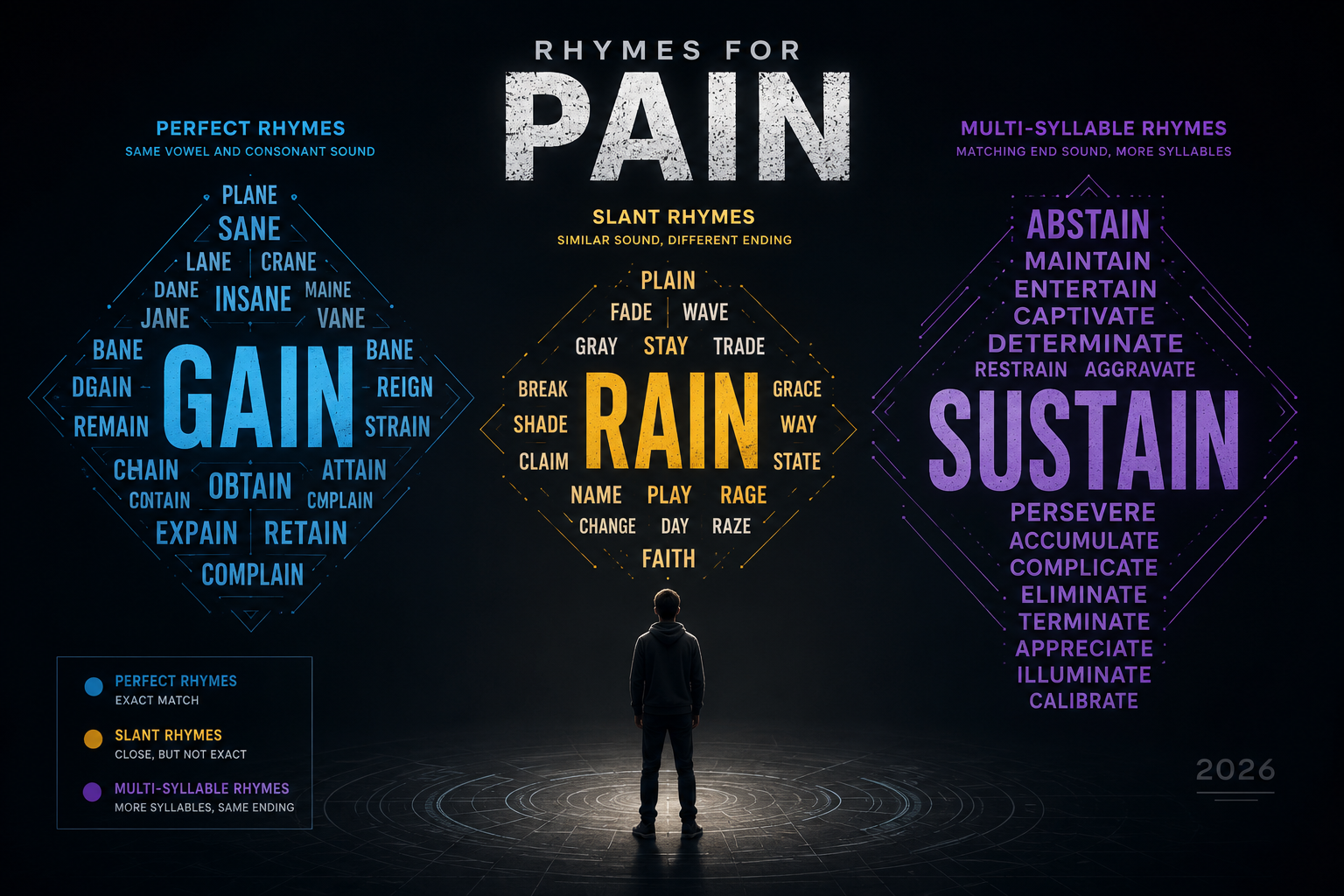
What Are Some Perfect Rhymes for Pain?
Perfect rhymes for "pain" are words where the final stressed vowel and all subsequent sounds are identical, while the preceding consonant sounds are different. These create the strongest, most musically satisfying rhyme connections.
Here's a comprehensive list of perfect rhymes for "pain," covering a range of common and less common options:
-
Brain
-
Chain
-
Cain (as in Abel's brother)
-
Dane (a person from Denmark)
-
Drain
-
Fane (a temple or church)
-
Gain
-
Grain
-
Lane
-
Main
-
Mane (of a horse or lion)
-
Plane
-
Rain
-
Rein (a strap for guiding a horse)
-
Reign (rule as a monarch)
-
Sprain
-
Stain
-
Strain
-
Swain (a country youth or lover)
-
Train
-
Twain (two, a pair)
-
Vain
-
Vein
-
Wain (an archaic term for a wagon)
Using perfect rhymes for "pain" can lend a sense of completeness and musicality to your verses, making lines feel resolved and impactful. For example, a songwriter might choose "rain" and "pain" to evoke a melancholic mood, while a rapper might use "gain" and "pain" to highlight a struggle for success.
What Are Some Slant Rhymes for Pain?
Slant rhymes, also known as near rhymes, half rhymes, or imperfect rhymes, involve words that share similar, but not identical, sounds, either the vowel sounds match but the consonants differ, or the consonants match but the vowels differ. These offer flexibility and can introduce a more sophisticated, less predictable feel to your lyrics.
Here's a breakdown of effective slant rhymes for "pain":
-
Vowel Rhymes (Assonance): Words where the "ai" sound in "pain" is echoed, but the ending consonant differs.
-
Same: "It's always the same refrain."
-
Game: "Playing a dangerous game."
-
Blame: "Bearing all the heavy blame."
-
Fame: "Chasing the elusive fame."
-
Flame: "A burning, vibrant flame."
-
Name: "Whispering a forgotten name."
-
Shame: "A heavy burden of shame."
-
Grade: "Struggling to make the grade."
-
Fade: "Watching memories slowly fade."
-
Made: "A promise that was truly made."
-
Ache: "A dull and persistent ache."
-
Break: "When everything starts to break."
-
Fate: "Accepting an inevitable fate."
-
Hate: "A feeling I truly hate." (explore more rhymes for 'hate')
-
Late: "Arriving regrettably late."
-
-
Consonant Rhymes (Consonance): Words where the "n" sound from "pain" is repeated, but the vowel sound is different.
-
Dawn: "The quiet beauty of the dawn."
-
Gone: "Everything I once held is gone."
-
Lone: "Walking this path all lone."
-
Bone: "Feeling it right in my bone."
-
Sown: "Seeds of doubt are deeply sown."
-
Run: "The journey I have to run."
-
Sun: "Basking beneath the summer sun."
-
Fun: "A moment of simple, pure fun."
-
Ton: "A heavy, burdensome ton."
-
Plan: "Following a meticulous plan."
-
Man: "The struggles of an everyday man."
-
Can: "Knowing that I truly can."
-
-
Near Rhymes (Syllable Match): Words that sound similar but don't fall strictly into assonance or consonance.
-
Again: "I'll try my very best again."
-
Refrain: "Singing the same old sad refrain."
-
Complain: "No time left to just complain."
-
Maintain: "Working hard to just maintain."
-
Obtain: "A goal I strive to obtain."
-
Slant rhymes are particularly valuable for avoiding forced or predictable lyricism. They allow writers to prioritize meaning and natural phrasing while still maintaining a poetic rhythm, as often seen in modern rap and indie songwriting.
What Are Some Multi-Syllable Rhymes for Pain?
Multi-syllable rhymes for "pain" add complexity, sophistication, and a more intricate musicality to lyrics, making them especially favored by experienced rappers and poets. These rhymes typically involve a word or phrase where one of the syllables perfectly or nearly rhymes with "pain."
Here are several multi-syllable options, categorized for clarity:
-
Perfect Multi-Syllable Rhymes (ending in -ain):
-
Abstain: "Difficult choices, I must abstain."
-
Attain: "A dream I hope to soon attain."
-
Campaign: "Launching a powerful campaign."
-
Complain: "Always finding something to complain."
-
Constrain: "Feeling too many rules constrain."
-
Detain: "Forces that seek to detain."
-
Disdain: "Looking upon them with disdain."
-
Enchain: "Caught in thoughts that enchain."
-
Explain: "A complex story to explain."
-
Maintain: "A delicate balance to maintain."
-
Obtain: "Something new I wish to obtain."
-
Ordain: "A divine purpose to ordain."
-
Pertain: "Facts that strictly pertain."
-
Refrain: "Singing a melancholy refrain."
-
Regain: "A lost footing I must regain."
-
Remain: "Hoping a little strength will remain."
-
Restrain: "Trying hard to restrain."
-
Retain: "Important memories I retain."
-
Sustain: "Efforts to nourish and sustain."
-
Unchain: "Breaking free, seeking to unchain."
-
-
Near Multi-Syllable Rhymes (assonance/consonance):
-
Again: "Trying bravely again."
-
Displace: "The feelings I cannot displace."
-
Ingrain: "Habits that deeply ingrain."
-
Proclaim: "A message I wish to proclaim."
-
Redeem: "Actions that might redeem."
-
Sincere: "A heartfelt, truly sincere." (find more rhymes for 'clear')
-
Afflict: "Sorrows that truly afflict."
-
Regress: "Falling back, starting to regress."
-
Compare: "No one else could ever compare."
-
Despair: "Lost in the depths of despair."
-
Farewell: "Whispering a sad farewell."
-
Prepare: "For what the future might prepare."
-
Repair: "Something broken I wish to repair."
-
Unfair: "Life can sometimes be unfair."
-
Across the plain: "Wandering lonely across the plain." (This is a phrase-rhyme, where a phrase ends with a word rhyming with "pain.")
-
Using multi-syllable rhymes for "pain" can create a more intricate and engaging flow in your lyrical work. It challenges the listener while showcasing linguistic dexterity, moving beyond simple AABB patterns to more complex internal rhymes and layered sounds.
What Words Rhyme With 'Pain' for Rap Songs?
For rap songs, words that rhyme with "pain" often prioritize impact, cleverness, and versatility, leaning heavily on both perfect and slant rhymes, as well as multi-syllabic and phrase rhymes. Rappers frequently blend these to create intricate rhyme schemes that drive narratives and showcase lyrical skill in 2026.
Here’s a selection tailored for rap:
-
Gritty & Direct Perfect Rhymes:
-
Gain: "From struggle comes the gain."
-
Drain: "Watching all the fake ones drain."
-
Strain: "Under pressure, I won't strain."
-
Maintain: "My focus is what I maintain."
-
Chain: "Breaking every mental chain."
-
Explain: "No need for me to explain."
-
-
Clever Slant & Near Rhymes:
-
Game: "Survival in this concrete game."
-
Fame: "Chasing the elusive fame."
-
Name: "Making sure they remember my name."
-
Blame: "Ain't nobody else to blame." (explore more rhymes for 'blame')
-
Shame: "No room for fear or shame."
-
Plan: "Sticking to the master plan."
-
Man: "Real talk from a real man."
-
Gone: "Everything I valued is gone."
-
-
Multi-Syllable & Phrase Rhymes for Flow:
-
Disdain: "For the weak, I show disdain."
-
Sustain: "Ambition I always sustain."
-
Again: "Bounce back, rise up again."
-
Champagne: "Celebrating with champagne."
-
My domain: "King of my own domain."
-
No refrain: "Spitting truth, with no refrain."
-
Through the rain: "Had to walk through all the rain."
-
Rappers often look for internal rhymes and half-rhymes to maintain a consistent flow without sacrificing meaning. For instance, a line like "I feel the pain, then I find my lane" uses a direct rhyme, while "The city lights gleam, reflecting the dream" utilizes a slant rhyme for texture. The goal is often to surprise the listener with unexpected word choices that still fit the rhythm and narrative.

What Words Rhyme With 'Pain' for Love Poems?
For love poems, rhymes for "pain" can evoke a spectrum of emotions, from the sorrow of separation to the bittersweet joy of enduring love. Poets often choose softer, more evocative words, or use slant rhymes to create a nuanced and tender tone.
Here are rhyme options specifically suited for the delicate nature of love poetry:
-
Evocative Perfect Rhymes:
-
Rain: "Tears fall like soft, gentle rain, mirroring my pain."
-
Plain: "The truth of my heart, laid bare and plain, easing the pain."
-
Main: "Your love is the anchor, my life's true main, soothing all pain."
-
Gain: "Though heartache brings its bitter pain, your memory brings such gain."
-
Remain: "In my heart, your presence will remain, despite the lingering pain."
-
-
Tender Slant & Near Rhymes:
-
Name: "Whispering your beloved name, a balm to every pain."
-
Same: "Through all our changes, love remains the same, conquering every pain."
-
Flame: "Our love, an eternal flame, outshining all pain."
-
Grace: "Your gentle touch, a moment of grace, erasing all pain."
-
Embrace: "Lost in your comforting embrace, banishing every pain."
-
Tear: "A solitary, silent tear, for the sorrows that bring pain." (explore more rhymes for 'clear')
-
Fear: "Together we conquer every fear, and numb the deep pain." (explore more rhymes for 'year')
-
Long: "For your return, my spirit does long, despite the constant pain."
-
-
Multi-Syllable Poetic Rhymes:
-
Sustain: "Your love is the strength I sustain, through moments of deep pain."
-
Maintain: "This fragile hope I will maintain, in spite of all the pain."
-
Disdain: "No bitterness, no harsh disdain, just acceptance of the pain."
-
Complain: "No heart could ever truly complain, when love triumphs over pain."
-
Again: "I’d brave the hurt a thousand times again, to know your love, despite the pain."
-
When crafting love poems, the emphasis is often on emotional resonance and subtle beauty. Slant rhymes can be particularly effective, creating a softer, less insistent rhythm that mirrors the complex emotions of love and loss.
Are There Any Words That Almost Rhyme With Pain But Not Quite?
Yes, words that "almost" rhyme with "pain" are essentially slant rhymes or near rhymes, where there's a strong phonetic similarity but not a perfect match. These are crucial for writers who want to avoid predictable rhymes or to introduce a subtle musicality without strict adherence to perfect rhyming.
These words share either the vowel sound (assonance) or the consonant sound (consonance) with "pain," but not both in the exact rhyming position.
-
Assonance (Vowel Match):
-
Lake: Shares the long 'A' sound.
-
Wake: Similar long 'A' sound.
-
Break: Similar long 'A' sound.
-
Date: Long 'A' sound with a different end consonant.
-
Face: Long 'A' sound, different end.
-
Grace: Again, long 'A' sound.
-
Make: Long 'A' sound.
-
Shake: Long 'A' sound.
-
Fate: (more rhymes for 'hate')
-
Blade: Similar vowel.
-
-
Consonance (Consonant Match):
-
Run: Shares the 'n' sound.
-
Sun: Shares the 'n' sound.
-
Done: Shares the 'n' sound.
-
Gone: Shares the 'n' sound.
-
Lone: Shares the 'n' sound.
-
Born: Shares the 'n' sound, but a different vowel.
-
Shine: Shares the 'n' sound, but a different vowel. (more rhymes for 'mine')
-
Fine: Shares the 'n' sound, different vowel.
-
Tone: Shares the 'n' sound.
-
Down: Shares the 'n' sound.
-
These "almost" rhymes allow for greater creative freedom. A poet might use "pain" and "face" to connect physical suffering with an expression, creating a rich emotional layer without a jarring, forced perfect rhyme. Rappers often leverage these to maintain rhythmic flow and inject clever wordplay.
What's the Difference Between a Perfect Rhyme and a Near Rhyme?
The fundamental difference between a perfect rhyme and a near rhyme lies in the precision of their phonetic matching. Understanding this distinction is crucial for any songwriter, rapper, or poet aiming to master their craft in 2026.
Perfect Rhyme vs. Near Rhyme:
-
Definition — Perfect rhyme: identical stressed vowel sounds and everything after, with different preceding consonants. Near rhyme: similar but not identical sounds, matching either vowels (assonance) or consonants (consonance).
-
Example with "Pain" — Perfect: rain, gain, strain. Near: name, game, done, sun, fate, break.
-
Sound Quality — Perfect: strong, clear, definitive. Near: subtle, nuanced, suggestive.
-
Impact — Perfect: creates a strong sense of closure or emphasis. Near: adds texture and complexity, prevents predictability.
-
Flexibility — Perfect: less flexible, requires an exact match. Near: highly flexible, allows more natural phrasing.
-
Usage — Perfect: common in pop, traditional poetry, rap punchlines. Near: prevalent in modern poetry, rap, folk, alternative music.
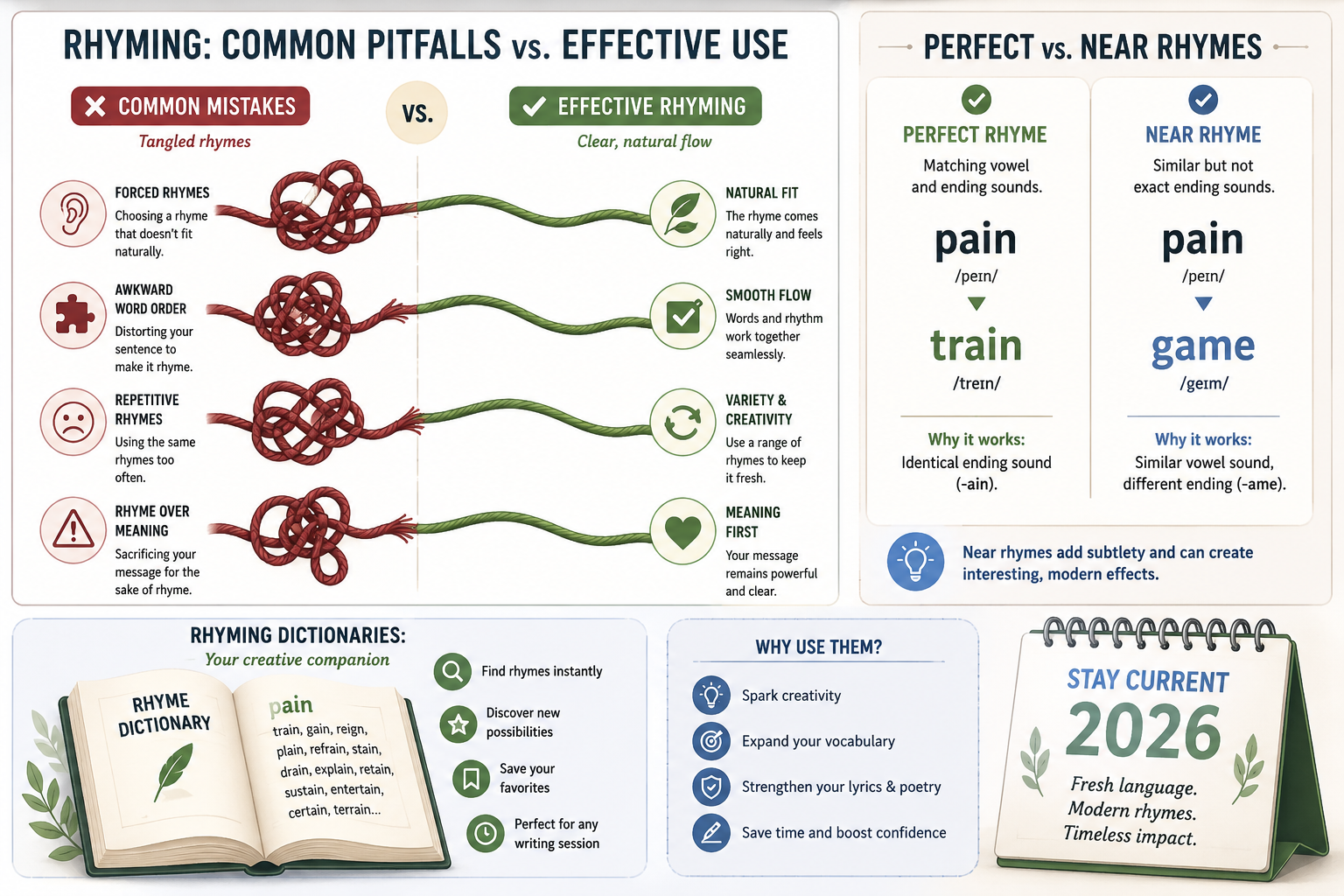
A perfect rhyme (like pain and rain) offers a complete sonic echo, often used for emphasis, a sense of finality, or to create strong melodic patterns. A near rhyme (like pain and game) creates a softer, more subtle connection. It allows writers to prioritize meaning and natural speech patterns without sacrificing all musicality, giving their work a more sophisticated and less predictable rhythm.
How Can I Find More Rhyming Words Easily?
Finding rhyming words easily in 2026 involves leveraging a combination of digital tools and a disciplined creative approach. The goal is to expand your lexical arsenal beyond the obvious.
-
Use Online Rhyming Dictionaries: These are the most powerful tools. Simply type in "pain," and they generate lists of perfect, slant, and multi-syllable rhymes. Websites like RhymeItNow are excellent starting points.
-
Employ Thesauruses for Synonyms: Sometimes, a perfect rhyme for your target word is elusive, but a synonym might open up new rhyming possibilities. For instance, if you can't rhyme directly with "pain," consider synonyms like "ache" or "suffer" and find rhymes for those.
-
Explore Reverse Dictionaries: These tools allow you to describe a concept or meaning, and they suggest words. While not directly for rhyming, they can help you find alternative words that then have better rhyming options.
-
Practice Phonetic Breakdown: Break your target word ("pain") into its core sounds (P-AY-N). Then, actively think of other words that share that AY-N sound, or just the AY sound, or just the N sound. This trains your ear for slant rhymes.
-
Read and Listen Widely: Pay attention to how professional lyricists and poets use rhymes. Keep a notebook handy to jot down interesting word pairings or internal rhymes you encounter.
-
Utilize Mobile Apps: Many rhyming dictionary apps are available for smartphones, offering on-the-go assistance for creative writers.
-
Brainstorm Related Concepts: Think about concepts associated with "pain" (e.g., hurt, suffering, agony, healing, medicine). Brainstorming these related ideas can sometimes lead you to a word that rhymes better with "pain" or offers a new angle.
For songwriters and rappers, speed and breadth are key, making digital tools invaluable for generating a wide array of options in minutes. For poets, a more deliberate and thoughtful exploration of subtle connections might be preferred.
What Are Some Rhyming Dictionaries for Songwriters?
Rhyming dictionaries are indispensable tools for songwriters, rappers, and poets, offering comprehensive lists of words that rhyme perfectly, imperfectly, or even sound similar. In 2026, digital platforms provide the most accessible and powerful options.
Here are some of the best rhyming dictionaries for songwriters:
-
RhymeItNow.com: This platform offers an extensive database with filters for perfect, slant, and multi-syllable rhymes. It's user-friendly and great for quick brainstorming, providing a wide range of words for any target. You can directly explore rhymes for 'pain' there.
-
RhymeZone.com: One of the oldest and most comprehensive online rhyming dictionaries. It provides perfect rhymes, near rhymes, synonyms, antonyms, homophones, and even words that relate to the meaning of your search term, making it incredibly versatile.
-
The Rhymer (writeexpress.com): This tool is praised for its ability to find both perfect and near rhymes, and it often includes options for multi-word phrases, which can be very useful for rappers.
-
Google Search: While not a dedicated rhyming dictionary, typing "words that rhyme with [your word]" or "rhymes for [your word]" into Google often brings up various rhyming dictionary results and even quick lists directly in the search snippets.
-
Physical Rhyming Dictionaries: For those who prefer a tactile experience, traditional rhyming dictionaries like "The New Rhyming Dictionary and Poets' Handbook" remain valuable resources for detailed phonetic breakdowns and historical usage.
When choosing a rhyming dictionary, consider what features are most important to your process, such as the ability to filter by syllable count, rhyme type, or even part of speech. Many of these resources also provide options for finding rhymes for 'write', rhymes for 'truth', or other common lyrical words.
What Are Some Common Mistakes When Using Rhymes?
Even experienced writers can fall into common traps when using rhymes, which can detract from the overall quality of their work. Being aware of these pitfalls in 2026 can help refine your lyrical and poetic craft.
Here are some common mistakes to avoid:
-
Forced Rhymes (Rhyming for Rhyme's Sake): This is perhaps the most egregious error. It occurs when a writer chooses a word solely because it rhymes, even if it feels unnatural, doesn't fit the context, or sounds clunky. This sacrifices meaning for mere sound.
- Correction: Prioritize meaning and natural phrasing. If a perfect rhyme isn't working, switch to a slant rhyme or rephrase the entire line.
-
Predictable or Obvious Rhymes: Overusing common, easy rhymes (e.g., "love/dove," "moon/June") can make lyrics feel uninspired and cliché. While these have their place, relying on them exclusively can bore the audience.
- Correction: Explore slant rhymes, multi-syllable options, and less common perfect rhymes to add freshness.
-
Internal Rhyme Overload: While internal rhymes (rhymes within a single line) can add flair, too many in a short space can make a line feel cluttered or like a tongue-twister, hindering comprehension.
- Correction: Use internal rhymes sparingly and strategically to highlight specific words or create a subtle rhythmic pulse.
-
Lack of Variety: Sticking to one type of rhyme scheme (e.g., always AABB) can make a song or poem monotonous.
- Correction: Experiment with different schemes (ABAB, ABCB, free verse with occasional rhymes) and mix perfect with slant rhymes.
-
Rhyming Only at the End of Lines: While traditional, exclusive end-rhyming can sometimes lead to a "sing-songy" quality.
- Correction: Incorporate internal rhymes, assonance, and consonance throughout lines to add musicality without always relying on the final word.
-
Incorrect Stress/Accent: For a rhyme to work well, the stressed syllable of the rhyming words should ideally align. Mismatched stress can make the rhyme sound off or awkward.
- Correction: Say the words aloud to ensure the natural pronunciation and emphasis align.
-
Ignoring Context and Tone: A rhyme that works in a humorous rap might be completely inappropriate for a serious poem.
- Correction: Always consider the emotional and thematic context of your work when selecting rhymes.
By consciously avoiding these mistakes, writers can ensure their rhymes enhance rather than detract from their creative expression, leading to more polished and impactful work.
What Words Should I Avoid Rhyming With 'Pain'?
While creative expression has few hard rules, certain rhyming choices with "pain" might be considered weak, clichéd, or difficult to make sound natural, depending on the context. Avoiding these can elevate your writing in 2026.
Here are categories of words or approaches to be cautious with:
-
Overused & Clichéd Rhymes:
-
Rain: While a perfect rhyme, "pain and rain" is highly common and can feel unoriginal if not paired with a fresh concept.
-
Again: Often used as a filler word just to get a rhyme, making the line feel less purposeful.
-
Complain: Can often lead to predictable or whining sentiments, unless used intentionally for that effect.
-
Vain: Another common perfect rhyme that might feel uninspired if not carefully integrated.
-
Consideration: If you use these, ensure the surrounding lyrics are exceptionally strong or twist the cliché in an interesting way.
-
-
Forced or Strained Rhymes: These are words that technically rhyme but feel out of place semantically or rhythmically.
-
Fane: An archaic word for a temple; unless you're writing a historical or highly literary piece, it can sound anachronistic and forced.
-
Wain: An obsolete term for a wagon or cart; similar to "fane," it can pull the reader out of a modern context.
-
Twain: While technically correct, its primary association with Mark Twain can be distracting if not used carefully.
-
Consideration: Always check if the word truly serves your meaning and doesn't sound like you're just "filling a slot."
-
-
Words that Undermine Tone: Rhymes that clash with the serious or emotional nature often associated with "pain."
-
Using overly silly or childish rhymes (e.g., trying to force a connection to "train" in a deeply melancholic piece in a way that trivializes the emotion).
-
Consideration: Ensure the chosen rhyme maintains or enhances the intended emotional weight of "pain."
-
-
Rhymes that Create Awkward Phrasing: Sometimes a word rhymes, but constructing a natural-sounding sentence around it becomes difficult, leading to convoluted syntax.
- Consideration: Read your lines aloud. If they stumble or sound unnatural, the rhyme might be forcing the language too much.
The best strategy is to prioritize meaning and natural flow. If a rhyme for "pain" feels forced, clichéd, or detracts from your message, it's usually better to opt for a strong slant rhyme, rewrite the line, or even use free verse for that section.
What Are Some Good Tips for Using Rhymes in Lyrics?
Using rhymes effectively in lyrics goes beyond simply finding matching sounds; it involves strategic choices that enhance meaning, rhythm, and emotional impact. For songwriters, rappers, and poets in 2026, these tips can help refine their approach.
-
Prioritize Meaning Over Rhyme: Never sacrifice the clarity or emotional weight of your message just to hit a rhyme. A slightly imperfect rhyme that conveys powerful meaning is always better than a perfect rhyme that feels forced or nonsensical.
-
Vary Your Rhyme Schemes: Don't stick to predictable AABB couplets throughout an entire song. Experiment with ABAB, ABCB, AAAA, or even internal rhymes (words rhyming within a single line). This keeps the listener engaged and adds musical complexity.
-
Use Slant Rhymes Strategically: Slant rhymes are your secret weapon. They offer flexibility, allow for more natural language, and can create a subtler, more sophisticated sound than constant perfect rhymes. They're excellent for avoiding clichés.
-
Embrace Internal Rhymes: Rhymes that occur within a line (e.g., "The cold took its toll on my soul") add a rich texture and can maintain rhythmic flow without needing end-of-line matches. They are particularly popular in rap for intricate wordplay.
-
Consider Multi-Syllable Rhymes: Words like "disdain" or "maintain" for "pain" demonstrate lyrical skill and can add a sense of sophistication and musicality, especially in genres like rap where lyrical dexterity is highly valued.
-
Read and Sing Aloud: Always read your lyrics aloud to check the flow, rhythm, and how the rhymes sound. Sometimes, what looks good on paper feels awkward when spoken or sung. This also helps catch unintended stresses or clunky phrasing.
-
Don't Be Afraid of No Rhyme: Some lines or sections might be more impactful without a rhyme, creating a sense of natural speech or emphasizing a particular statement. Free verse has its power.
-
Study Master Lyricists: Analyze the works of your favorite songwriters, rappers, and poets. Pay attention to how they use rhymes, when they break patterns, and how they combine different types of rhymes to achieve their desired effect.
-
Use Rhyming Dictionaries as Brainstorming Tools: Don't let a dictionary write your lyrics. Use it to generate ideas and expand your options, then select the words that genuinely fit your narrative and artistic vision.
By integrating these tips, writers can move beyond basic rhyming to craft lyrics that are both technically proficient and deeply expressive.
What if I Can't Find a Good Rhyme for Pain?
If you can't find a good rhyme for "pain" that feels natural and serves your lyrics, don't force it. There are several effective strategies to overcome this common creative block without compromising the quality of your work in 2026.
-
Use a Strong Slant Rhyme: Instead of a perfect rhyme, opt for a near rhyme like "name," "game," "fate," or "break." These offer a phonetic connection without needing an exact match, providing flexibility and often sounding more sophisticated.
-
Rephrase the Line: Sometimes the issue isn't the lack of rhymes for "pain," but how you've phrased the line. Try rewording the sentence so that a different key word ends the line, a word for which you do have good rhymes.
-
Original thought: "I feel the endless pain."
-
Rephrased: "The hurt inside me runs so deep." (Now you can rhyme with "deep" - e.g., "sleep," "keep," "weep.")
-
-
Move "Pain" to an Internal Position: Instead of making "pain" the end-of-line word, place it earlier in the line. This allows you to rhyme the new end-of-line word, while still incorporating "pain" into your message.
- Example: "The pain is strong, but I will carry on." (Now you can rhyme with "on.")
-
Use a Multi-Syllable Phrase Rhyme: If a single word doesn't work, consider a short phrase that ends with a word rhyming with "pain."
- Example: "The struggle I must sustain" or "It runs through every vein."
-
Employ Free Verse (No Rhyme): For that particular line or even a whole section, consider dropping the rhyme entirely. Not every line needs to rhyme, especially in modern poetry and songwriting. A strong, unrhymed line can sometimes be more impactful and genuine than a forced rhyme.
-
Utilize Assonance or Consonance: Focus on just the vowel sound (assonance, e.g., "pain" and "fade") or just the consonant sound (consonance, e.g., "pain" and "run") to create a subtle musicality without a full rhyme.
-
Consult a Thesaurus for Synonyms: Look up synonyms for "pain" (e.g., "ache," "agony," "distress," "hurt"). Then, search for rhymes for those words. This opens up entirely new rhyming avenues. For example, rhymes for 'heal' might offer a contrasting perspective if you're exploring the opposite of pain.
The key is flexibility. Don't let the pursuit of a perfect rhyme stifle your creativity or force unnatural language. The best lyrics flow authentically, whether they rhyme perfectly or not.
FAQ
What are perfect rhymes for "pain"?
Perfect rhymes for "pain" are words where the final stressed vowel and all subsequent sounds match, such as "gain," "rain," "drain," "strain," and "brain."
Can I use "same" as a rhyme for "pain"?
Yes, "same" is a valid slant rhyme (or near rhyme) for "pain" because they share the same vowel sound. It creates a softer, less precise connection than a perfect rhyme.
What's a multi-syllable rhyme for "pain"?
Multi-syllable rhymes for "pain" often include words like "disdain," "sustain," "maintain," "explain," and "abstain," where the final syllable rhymes perfectly with "pain."
Is it always best to use perfect rhymes?
No, it's not always best to use perfect rhymes. Slant rhymes and multi-syllable rhymes can add complexity, sophistication, and prevent lyrics from sounding predictable or forced, making them essential for varied lyrical compositions.
What rhyming dictionaries are good for songwriters?
Online rhyming dictionaries like RhymeItNow.com and RhymeZone.com are excellent resources for songwriters, offering extensive lists of perfect, slant, and multi-syllable rhymes.
How can rappers use rhymes for "pain" effectively?
Rappers often use a mix of sharp perfect rhymes for punchlines, clever slant rhymes for intricate flow, and multi-syllable rhymes to showcase lyrical skill, making word choice impactful and dynamic.
Should I avoid rhyming "pain" with "again"?
While "again" is a perfect rhyme for "pain," it can be overused and feel clichéd. It's best to use it sparingly or in a context that adds a fresh perspective rather than resorting to it as a default.
What if I can't find any good rhyming words for "pain"?
If you struggle to find a good rhyme, consider using a strong slant rhyme, rephrasing the line to change the end word, moving "pain" to an internal position in the line, or simply opting for no rhyme in that section (free verse).
Conclusion
Mastering words that rhyme with "pain" is a vital skill for songwriters, rappers, and poets alike, providing a rich tapestry of sounds to articulate one of humanity's most profound experiences. In 2026, the modern lyricist has access to a wealth of tools and techniques, from the strong resolution of perfect rhymes like "gain" and "drain" to the subtle emotional resonance of slant rhymes such as "name" or "fate." Multi-syllable options like "sustain" or "disdain" further enhance lyrical complexity, offering pathways to more intricate and engaging compositions.
The key to effective rhyming is balance: prioritizing meaning, experimenting with different rhyme schemes, and knowing when to use a perfect match versus a more nuanced near rhyme. By avoiding forced or clichéd combinations and leveraging digital resources, you can craft powerful, memorable verses that truly connect with your audience. Don't be afraid to break traditional rules or rephrase lines if a rhyme doesn't feel right. Your artistic voice and the authenticity of your message should always guide your choices.
Find the perfect rhyme for your next song
Try RhymeItNow →