Best Words That Rhyme With Time — For Songwriters & Rappers
2026-06-29

Last updated: June 29, 2026
When crafting lyrics, the word "time" is a constant, yet finding fresh and impactful "words that rhyme with time" can often feel like a creative hurdle for songwriters and rappers. This guide provides a comprehensive list of perfect, near, and slant rhymes, along with practical strategies and common pitfalls to avoid, ensuring your lyrics always feel innovative and never forced.
Key Takeaways
-
Perfect Rhymes are Abundant: Words like "chime," "crime," "dime," and "prime" offer strong, direct connections to "time."
-
One-Syllable Rhymes Offer Impact: Single-syllable words provide crisp, punchy rhymes often preferred in rap and energetic tracks.
-
Slant Rhymes Add Nuance: Words like "design," "divine," "stride," and "guide" offer a more subtle, sophisticated rhyme that adds depth without being jarring.
-
Context is King: The best rhyme isn't just about sound; it's about how it serves your song's theme and emotional tone.
-
Avoid Forced Rhymes: Don't sacrifice meaning or natural flow for a perfect rhyme; sometimes a slant rhyme or rephrasing is better.
-
Rhyming Dictionaries are Tools: Use online resources like RhymeItNow.com to expand your vocabulary, but always filter results creatively.
-
Practice with Phrases: Experiment with multi-word rhymes and internal rhymes to elevate your lyrical complexity.
-
Consider Word Feeling: Choose rhymes that align with the mood you're trying to create, whether it's love, introspection, or aggression.
What Are Some Common Words That Rhyme With Time?
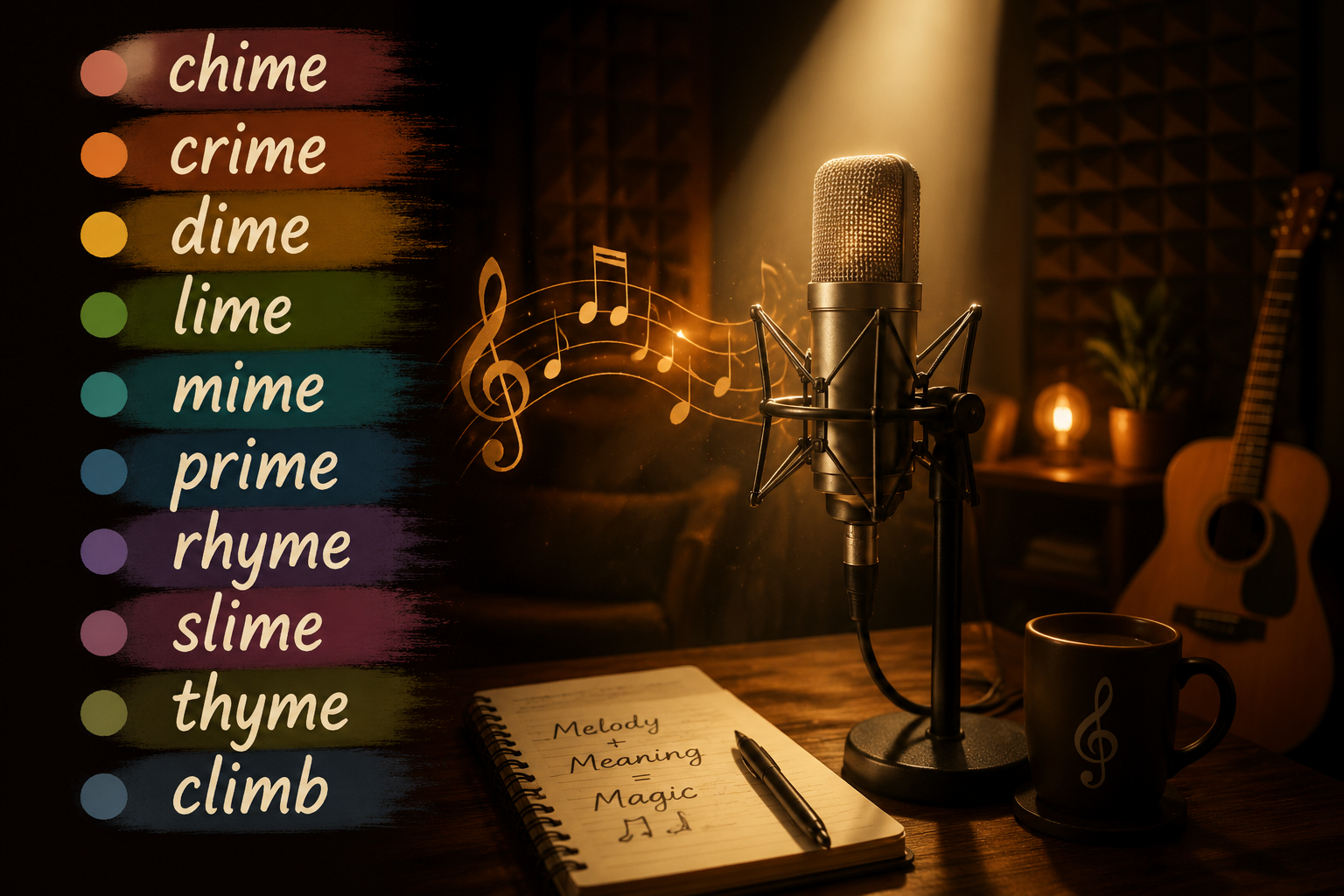
Common words that rhyme perfectly with "time" are typically one-syllable words that share the exact "ime" sound, making them readily available and easy to integrate into lyrics. These rhymes are strong and clear, ensuring immediate recognition for the listener, which is ideal for impactful choruses or memorable lines.
These are the go-to choices for many writers because they create a clean, satisfying sonic match. They include both everyday vocabulary and words that carry specific emotional weight.
Everyday Perfect Rhymes for 'Time'
-
Chime: Often associated with bells, pleasant sounds, or agreements.
-
Crime: Refers to illegal acts, often used in narratives of conflict or consequence. Check out more rhymes for crime.
-
Dime: A ten-cent coin, frequently used idiomatically (e.g., "drop a dime").
-
Fime: An archaic word for foam or froth, rarely used in modern English.
-
Grime: Dirt, soot, or filth, often evoking a sense of harshness or decay.
-
Lime: A green citrus fruit, or the mineral calcium oxide.
-
Mime: To imitate or a performer who acts without words.
-
Prime: Best, excellent, or the most important.
-
Rhyme: The central concept of this article! A correspondence of sound between words.
-
Slime: A viscous, unpleasant substance.
-
Thyme: An aromatic herb.
Less Common Perfect Rhymes
-
Clime: A region considered with reference to its climate.
-
Glaive: A type of sword, often found in fantasy or historical contexts.
-
Sublime: Of such excellence, grandeur, or beauty as to inspire great admiration or awe.
-
Paradigm: A typical example or pattern of something; a model.
When selecting from these words, consider the existing imagery and theme of your song. For example, "chime" might fit a reflective or romantic piece, while "grime" is more suited for a gritty, realistic narrative.
What Are Good One-Syllable Words That Rhyme With Time?
One-syllable words that rhyme with "time" are especially effective in songwriting and rapping because they deliver a concise, punchy sound that maintains rhythm and flow without elongating lines. Their brevity allows for quick delivery and sharp impact, making them versatile for various lyrical styles.
These simple rhymes are often the most potent, providing a clear beat and direct sonic connection. They are excellent for creating emphasis and driving a point home.
Here’s a focused list of impactful one-syllable "words that rhyme with time":
-
Chime: Evokes sound, bells, or harmony.
-
Crime: Implies transgression, danger, or consequence.
-
Dime: Simple, relatable, monetary.
-
Grime: Suggests dirt, struggle, or urban reality.
-
Lime: Offers a fresh, natural, or tangy image.
-
Mime: Can suggest imitation, silence, or performance.
-
Mine: Possessive, personal, or a place of extraction. For other uses, see rhymes for mine.
-
Prime: Signifies peak condition, importance, or initiation.
-
Rhyme: Directly refers to lyrical craft.
-
Slime: Conjures unpleasant, sticky, or undesirable imagery.
-
Thyme: A simple, earthy, aromatic herb.
For example, a rap lyric might use "grime" to paint a picture of street life, while a pop song could use "chime" to describe a feeling of love or destiny. The brevity of these words helps maintain a strong percussive rhythm in vocal delivery.
What Words Rhyme With Time for Rap Songs?
For rap songs, the best "words that rhyme with time" often carry an edge, reflect urban realities, or offer opportunities for complex wordplay and internal rhymes. Rappers frequently utilize both perfect and slant rhymes to convey grit, ambition, or narrative depth, prioritizing lyrical ingenuity over strict adherence to perfect sounds.
The key in rap is not just the rhyme itself, but how it's delivered and what it communicates within the broader lyrical narrative. Words that offer vivid imagery or strong emotional resonance are highly valued.
Hard-Hitting Perfect Rhymes for Rap
-
Crime: A classic in rap, instantly evoking street narratives, justice, or rebellion. (e.g., "Doing time for the crime.")
-
Grime: Perfect for describing harsh realities, urban decay, or a tough exterior. (e.g., "From the grime, I rose to my prime.")
-
Slime: Can be used to refer to deceitful people, unpleasant situations, or a general sense of degradation. (e.g., "Stepping over the slime, gotta get mine.")
-
Prime: Suggests being at one's best, peak performance, or importance. (e.g., "This is my prime, ain't no turning back time.")
-
Dime: Often used in expressions of money or small, insignificant amounts, or even a beautiful woman ("a perfect dime"). (e.g., "Every dime, every rhyme, gotta shine.")
Slant Rhymes and Near Rhymes for Deeper Rap Lyrics
Slant rhymes are crucial in rap as they allow for more complex word choices and avoid predictability, while still providing a satisfying sonic connection.
-
Mind: Allows for introspection, thought processes, and psychological themes. (e.g., "Rewind the time, clear my mind.")
-
Find: Suggests discovery, pursuit, or determination. (e.g., "What you gonna find when you search through time?") More options at rhymes for find.
-
Sign: Can refer to omens, symbols, or signatures of authority.
-
Shine: Represents success, brilliance, or standing out.
-
Grind: A common rap term for hard work, hustle, and persistent effort. (e.g., "On the grind, every time.")
-
Decline: Conveys downfall, loss, or ending.
-
Define: To explain or establish the meaning, often used in self-definition. (e.g., "Let me define what I do with my time.")
-
Align: To bring into agreement or a straight line; often used for purpose or destiny.
-
Design: Refers to planning, purpose, or a creative blueprint.
-
Divine: Suggests something heavenly, excellent, or god-like, used for elevated status.
-
Supply: Providing resources or fulfilling needs, a common theme in hustling.
When choosing words for rap, consider multisyllabic rhymes for added complexity. For instance, pairing "time" with phrases that end with a similar sound, even if the primary stress isn't on the 'ime' sound, can create intricate flows. Think about how the feeling of the word contributes to the song's narrative. Using words like "grime" or "crime" can evoke a sense of struggle or authenticity, while "prime" or "shine" can speak to ambition and success.
What Words Rhyme With Time for Love Songs?
For love songs, "words that rhyme with time" should evoke tenderness, connection, longing, or passion, creating an emotional resonance that enhances the romantic theme. While perfect rhymes are often effective, slant rhymes can also add a sophisticated, less predictable feel, allowing for richer lyrical expression.
The goal is to select words that reinforce the song's central message of affection, devotion, or shared experience.
Tender Perfect Rhymes for Love Songs
-
Chime: Evokes pleasant sounds, harmony, or a feeling of destiny. (e.g., "Our hearts chime in perfect time.")
-
Prime: Can signify being at the best stage of life or the most important. (e.g., "You are my prime, my precious time.")
-
Sublime: Suggests something extraordinarily beautiful, magnificent, or awe-inspiring, perfect for profound declarations of love. (e.g., "Our love is truly sublime, defying all time.")
Evocative Slant Rhymes for Love Songs
Slant rhymes are excellent for adding depth and poetic nuance to love songs, allowing for a broader range of emotional expression.
-
Mine: A powerful possessive, expressing ownership and deep personal connection. (e.g., "Forever you'll be mine, through every single time.")
-
Divine: Implies something sacred, perfect, or sent from above, elevating the love described. (e.g., "Your love feels divine, a blessing in time.")
-
Shine: Represents brightness, joy, and the glow a loved one brings. (e.g., "Your presence makes my whole world shine, all the time.")
-
Find: Suggests discovery, destiny, or the joy of having found a soulmate. (e.g., "I'm so glad I got to find you, just in time.")
-
Kind: Expresses gentle affection, warmth, and compassion. For more options, explore rhymes for kind. (e.g., "Your gentle kind, eases my mind every time.")
-
Design: Can refer to a predetermined plan or fate, especially when speaking of two people meant to be together. (e.g., "It was designed, for us to meet in time.")
-
Forever: Though not a perfect rhyme, the ending "er" sound can create a compelling near rhyme with "time" for emotional impact, especially when emphasizing eternity. (e.g., "Our love will last forever, through changing time.")
-
Align: To bring into agreement, suggesting perfect compatibility or a shared path. (e.g., "Our souls align, for all time.")
When writing love songs, consider the imagery the rhyme evokes. "Chime" can suggest harmony and happiness, while "divine" can convey a sense of destiny and sacred connection. The emotional weight of the word should always align with the narrative of the song.
Are There Any Slant Rhymes for Time? What Words Almost Rhyme with Time?
Yes, there are numerous effective slant rhymes for "time," which are words that share a similar but not identical sound, offering more flexibility and subtlety in songwriting. Slant rhymes, also known as near rhymes, half rhymes, or imperfect rhymes, typically match either the vowel sound or the consonant sound, but not both, creating a less predictable and often more sophisticated lyrical texture.
Words that "almost rhyme with time" often share the long 'i' vowel sound or the 'm' ending consonant, providing a pleasing sonic echo without a perfect match.
Examples of Slant Rhymes for 'Time'
These words provide a similar sound or feel without being exact matches:
-
Words ending in '-ine' (matching vowel and ending consonant sound, but often with a different preceding consonant):
-
Mine: (As in "it's mine") – A very common and strong slant rhyme.
-
Shine: (e.g., "sun shine")
-
Fine: (e.g., "I'm fine")
-
Line: (e.g., "draw a line")
-
Divine: (e.g., "a divine presence")
-
Design: (e.g., "a clever design")
-
Define: (e.g., "to define a term")
-
Spine: (e.g., "the human spine")
-
Sign: (e.g., "a street sign")
-
Twine: (e.g., "wrap with twine")
-
Decline: (e.g., "a rapid decline")
-
Combine: (e.g., "to combine elements")
-
Align: (e.g., "to align goals")
-
Consign: (e.g., "to consign to history")
-
-
Words ending in '-ind' (matching vowel sound, similar ending consonant sound):
-
Find: (e.g., "to find a solution") – A very strong near rhyme.
-
Mind: (e.g., "my mind")
-
Kind: (e.g., "a kind gesture")
-
Bind: (e.g., "to bind together")
-
Grind: (e.g., "the daily grind")
-
Behind: (e.g., "look behind")
-
Unwind: (e.g., "to unwind and relax")
-
-
Words ending in '-ight' or '-ite' (matching vowel sound, different ending consonant sound):
-
Light: (e.g., "the morning light")
-
Fight: (e.g., "a tough fight")
-
Right: (e.g., "you are right")
-
Night: (e.g., "good night")
-
White: (e.g., "pure white")
-
Might: (e.g., "with all your might")
-
Site: (e.g., "a construction site")
-
Write: (e.g., "to write a letter")
-
Using slant rhymes can prevent your lyrics from sounding too simplistic or predictable. They are especially useful when a perfect rhyme feels forced or doesn't fit the lyrical meaning. For example, instead of forcing "grime" into a romantic song, "divine" or "design" might convey the intended meaning more effectively while still offering a subtle sonic connection to "time."
What's the Difference Between a Perfect Rhyme and a Slant Rhyme?
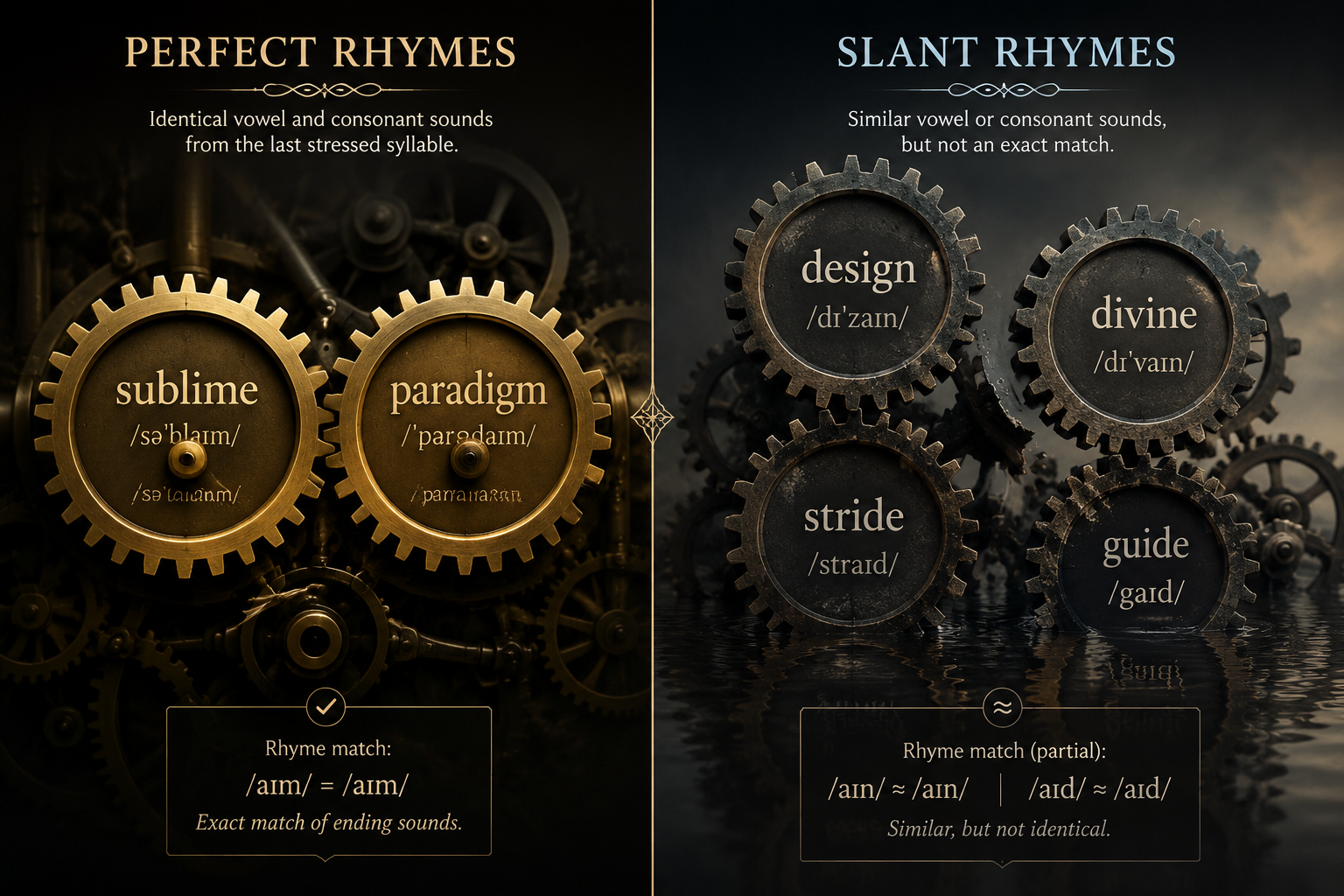
The primary difference between a perfect rhyme and a slant rhyme lies in the degree of phonetic similarity between words, impacting both the auditory experience and lyrical flexibility. A perfect rhyme achieves an exact match in the stressed vowel sound and all subsequent sounds, while a slant rhyme (also known as a near rhyme or imperfect rhyme) offers a partial sound match, typically aligning only the vowel or the consonant sounds.
Understanding this distinction is crucial for songwriters and rappers to consciously choose the desired lyrical effect.
Perfect Rhyme
-
Definition: Two words form a perfect rhyme when their stressed vowel sounds and all subsequent sounds are identical, but their preceding consonant sounds (if any) are different.
-
Example: "Time" and "Chime."
-
Stressed vowel sound: /aɪ/ (as in "eye")
-
Subsequent sounds: /m/
-
Preceding consonants: /t/ and /tʃ/ (different)
-
-
Effect: Perfect rhymes create a strong, clear, and satisfying sonic conclusion. They often feel definitive and can make lyrics feel memorable and catchy.
-
Usage: Commonly used in traditional poetry, pop songs, and choruses where a strong, immediate connection is desired.
Slant Rhyme (Near Rhyme, Half Rhyme, Imperfect Rhyme)
-
Definition: Two words form a slant rhyme when they share either the same stressed vowel sound (assonance) or the same ending consonant sound (consonance), but not both. They create a close but not exact sonic match.
-
Example 1 (Matching Vowel Sound): "Time" and "Light."
-
Stressed vowel sound: /aɪ/ (matches)
-
Subsequent sounds: /m/ and /t/ (different)
-
-
Example 2 (Matching Consonant Sound): "Time" and "Beam."
-
Stressed vowel sound: /aɪ/ and /i:/ (different)
-
Ending consonant sound: /m/ (matches)
-
-
Effect: Slant rhymes offer more lyrical freedom, allowing writers to choose words for their meaning or imagery without being strictly bound by exact sound. They create a sense of internal rhythm and sophistication, making lyrics less predictable and more nuanced.
-
Usage: Highly favored in modern poetry, rap, hip-hop, and alternative music where complex wordplay and subtle sonic textures are prioritized over strict adherence to perfect rhymes. They can convey a more conversational or introspective tone.
Choosing between a perfect and a slant rhyme depends on the specific intent. A perfect rhyme provides clarity and emphasis, while a slant rhyme allows for greater linguistic richness and a more organic, flowing feel, especially when a perfect rhyme might sound forced or cliché.
What's the Best Way to Find Rhymes for a Word?
The best way to find "words that rhyme with time" involves a combination of direct rhyming dictionaries, thesaurus use, and creative phonetic exploration to discover both obvious and subtle matches. Relying solely on one method can limit your options; a multi-pronged approach yields the most versatile and impactful results for songwriting and rap.
Effective rhyme-finding is an iterative process that balances technical accuracy with creative insight.
1. Utilize Online Rhyming Dictionaries
-
Direct Search: The quickest way to find a comprehensive list of rhymes. Simply type "time" into a rhyming dictionary.
-
Filter Options: Many advanced dictionaries allow you to filter by syllable count, type of rhyme (perfect, slant, end rhyme), and even related words.
-
Benefit: Provides a broad spectrum of options quickly, including words you might not immediately think of.
2. Leverage a Thesaurus
-
Semantic Connections: While not a rhyming tool directly, a thesaurus helps you find synonyms or related concepts to words that do rhyme with "time." For example, if "prime" rhymes with "time," a thesaurus might give you "peak," "best," "optimum," which can spark new lyrical ideas.
-
Indirect Rhyme Generation: By finding alternative ways to express your idea, you might stumble upon a concept that naturally leads to a word that rhymes with "time."
3. Explore Phonetic Similarities (Manual Exploration)
-
Vowel Sounds: Focus on words that share the long 'i' sound as in "eye" (e.g., "light," "high"). Then see if any of these can be modified to fit the ending 'm' sound, or used as a slant rhyme.
-
Consonant Sounds: Look for words ending with the /m/ sound, even if the vowel is different (e.g., "dream," "seem"). These can work as consonance slant rhymes.
-
Syllable Count: Consciously search for both one-syllable and multi-syllable rhymes depending on your rhythmic needs.
-
Reverse Engineering: If you have a phrase or idea, try to rephrase it in a way that naturally leads to a rhyming word. For instance, if you want to say "it's difficult," you might think of "it's a climb," where "climb" rhymes with "time."
4. Brainstorm Contextually Relevant Words
-
Theme First: Before looking for rhymes, consider the themes and emotions of your song. If it's about struggle, think of words associated with that: "grind," "climb," "decline."
-
Associated Imagery: If your song features clocks or watches, "chime" might be a natural fit. If it's about money, "dime" could work.
Example Rhyme-Finding Process:
-
Start with "time."
-
Consult a rhyming dictionary: Get "chime," "crime," "dime," "grime," "lime," "mime," "mine," "prime," "rhyme," "slime," "thyme," "sublime," "paradigm."
-
Look for slant rhymes: Consider words like "mind," "find," "kind," "shine," "design," "divine," "light," "right."
-
Check a thesaurus for concepts related to these rhymes:
-
"Prime" -> peak, best.
-
"Crime" -> transgression, sin. (See also rhymes for sin).
-
"Mind" -> thought, intellect.
-
"Shine" -> brilliance, success.
-
-
Integrate based on song theme: If writing a motivational song, "prime," "shine," and "grind" (from "mind") might be perfect. If a love song, "chime," "divine," and "mine."
By combining these methods, you'll uncover a rich tapestry of words, ensuring your lyrics are both resonant and diverse.
Are There Any Online Rhyming Dictionaries That Are Really Good?
Yes, several online rhyming dictionaries are highly recommended for their comprehensive databases, user-friendly interfaces, and advanced search features, making them invaluable tools for finding "words that rhyme with time" and other lyrical needs. These platforms go beyond simple end rhymes, often offering options for slant rhymes, multi-syllable rhymes, and even contextual suggestions.
A good rhyming dictionary can significantly boost a songwriter's or rapper's efficiency and creativity.
Top Online Rhyming Dictionaries
-
RhymeZone.com:
-
Features: Extremely popular and comprehensive. It finds perfect rhymes, slant rhymes, synonyms, antonyms, homophones, words with similar consonants, and words with similar vowels. You can search by syllable count.
-
Strengths: Very extensive database, offers many related word tools beyond just rhyming, making it a powerful brainstorming aid.
-
Why it's good: Its sheer breadth of options and ease of use make it a go-to for many lyricists.
-
-
RhymeItNow.com:
-
Features: Provides a clean, straightforward interface for finding various types of rhymes. It often categorizes results, making it easy to see perfect versus near rhymes. The site is designed to be intuitive and fast.
-
Strengths: Focuses primarily on delivering clear rhyming options without unnecessary clutter. It's excellent for quickly generating relevant lists.
-
Why it's good: Its simplicity and directness are ideal for users who want quick, actionable rhyme suggestions without getting bogged down by too many features. It can also help with words like rhymes for write or rhymes for light.
-
-
Rhymer.com:
-
Features: Offers a simple, effective interface. It provides exact rhymes, but also options for "first-syllable" and "last-syllable" rhymes, which can be useful for internal rhymes or specific phonetic searches.
-
Strengths: Good for traditional rhyming and exploring different sound connections.
-
Why it's good: A solid, reliable option that's easy to navigate for basic and slightly more advanced rhyming needs.
-
-
The Internet Archive (Project Gutenberg, etc.) for Poetry Anthologies:
-
Features: While not a dictionary, reading classic and contemporary poetry (available through digital archives) can expose you to how master poets use rhymes, including unusual ones, in context.
-
Strengths: Offers real-world examples and inspiration, showing how rhymes work within a larger artistic framework.
-
Why it's good: It provides practical context and demonstrates how rhymes contribute to rhythm, mood, and meaning, which can inform your own choices when looking for "words that rhyme with time."
-
When using these tools, remember that they are aids, not replacements for creative thought. Always filter the results through the lens of your song's meaning and emotional tone. A word might rhyme perfectly, but if its connotation doesn't fit, it's not the right choice.
What Are Some Common Mistakes When Trying to Rhyme Words?
When trying to find "words that rhyme with time" or any other word, common mistakes often stem from prioritizing rhyme over meaning, forcing awkward phrasing, or neglecting the rhythm and flow of the lyrics. These errors can make a song sound unnatural, cliché, or even nonsensical, undermining its overall impact.
Avoiding these pitfalls is as important as finding good rhymes, ensuring the lyrical quality remains high.
1. Forcing Rhymes That Don't Fit the Meaning
-
Mistake: Choosing a word solely because it rhymes, even if it makes little sense in the context of the lyric.
-
Example: "I love your smile, it's truly prime, / We've had a wonderful time." (Unless "prime" is specifically referring to her best smile, it feels clunky.)
-
Solution: Always check if the rhyming word enhances or at least aligns with the lyrical message. If not, consider a slant rhyme or rephrase the line entirely.
2. Sacrificing Natural Phrasing and Syntax
-
Mistake: Rearranging sentence structure in an unnatural way just to make two words rhyme, often leading to awkward phrasing.
-
Example: "To spend with you, I do desire / All of my precious time to aspire." (Instead of "I desire to spend all my precious time with you.")
-
Solution: Write the natural phrase first, then see if you can find a rhyme that fits. If not, adjust the original phrasing slightly or explore slant rhymes.
3. Over-reliance on Clichéd Rhymes
-
Mistake: Consistently using the most obvious or overused rhymes, making the lyrics predictable and unoriginal. For "time," this might mean always pairing it with "dime," "crime," or "rhyme" without much thought.
-
Solution: Challenge yourself to find less common perfect rhymes, or experiment with creative slant rhymes. Expand your vocabulary and explore different lyrical angles.
4. Ignoring Syllable Count and Rhythm
-
Mistake: Using rhyming words that disrupt the rhythmic flow or syllable count of your lines, especially in genres like rap or pop where rhythm is paramount.
-
Example: "We spend our precious time / Building a paradigm." (If the first line is short and punchy, the longer "paradigm" can feel out of place rhythmically.)
-
Solution: Pay attention to the number of syllables in your rhyming words and how they sit within the melody or beat. Sometimes, a one-syllable perfect rhyme is better for rhythm, even if a multi-syllable word offers more depth.
5. Not Experimenting with Slant Rhymes
-
Mistake: Only looking for perfect rhymes and missing out on the lyrical richness and flexibility that slant rhymes offer.
-
Solution: Deliberately seek out slant rhymes that match either the vowel or the consonant sound. This opens up many more possibilities and can make your lyrics sound more sophisticated and less forced.
By being mindful of these common errors, songwriters and rappers can craft more compelling, authentic, and memorable lyrics, even when dealing with frequently used words like "time."
What Words Rhyme With Time But Have a Different Meaning or Feeling?
"Words that rhyme with time" often carry distinct meanings and emotional nuances, allowing songwriters and rappers to inject varied sentiments into their lyrics while maintaining a strong sonic connection. The best lyrical choices leverage these differences to deepen the narrative or shift the mood of a song, moving beyond mere phonetic matching.
The feeling a word evokes—be it positive, negative, or neutral—is crucial for shaping the listener's emotional experience.
Here's a look at words that rhyme with "time" and their differing meanings/feelings:
Rhyming WordPrimary Meaning/FeelingUsage/ConnotationChimePleasant sound, harmony, agreementPositive, peaceful, romantic, spiritual (e.g., wedding bells, harmonious thoughts)CrimeIllegal act, wrongdoing, transgressionNegative, gritty, dangerous, rebellious, consequence (e.g., street life, moral dilemmas)DimeTen-cent coin, small amount of moneyNeutral to slightly negative (insignificant), colloquial, monetary, mundaneGrimeDirt, filth, soot, accumulation of unpleasantnessNegative, harsh, realistic, urban, struggle (e.g., working-class life, decay)LimeGreen citrus fruit, mineralNeutral, fresh, tangy, natural, exotic (e.g., tropical themes, zest for life)MimeImitate, performer who uses gesturesNeutral, artistic, performative, often quiet or mysterious (e.g., unspoken feelings)MinePossessive (belonging to me), excavation sitePersonal, ownership, greedy, sometimes territorial, or deep searching (e.g., self-discovery)PrimeBest, peak, excellent, essentialPositive, ambitious, successful, important, vital (e.g., "in my prime," top condition)RhymeCorrespondence of sound, poetic deviceNeutral, creative, artistic, self-referential (e.g., writing songs, craftsmanship)SlimeViscous, unpleasant substanceStrongly negative, repulsive, deceitful, corrupt (e.g., negative characters, dirty deals)SublimeOf such excellence, grandeur, or beauty as to inspire great admiration or aweHighly positive, elevated, artistic, spiritual, profound (e.g., breathtaking beauty, deep love)ParadigmA typical example, pattern, or model; a way of thinkingNeutral, intellectual, structural, transformative (e.g., changing perspectives, new systems)
When writing, consider the emotional arc you want to create. Using "chime" might set a hopeful or romantic mood, while "grime" could instantly establish a darker, more realistic tone. The deliberate choice of a rhyming word based on its feeling is a mark of skilled lyricism.
What Are Some Words That Rhyme With 'Times' (Plural)?

Finding "words that rhyme with times" (the plural form of 'time') requires a focus on words ending with an /aɪmz/ sound, which is less common than the singular 'time'. The plural 's' introduces a distinct phonetic ending, generally limiting the direct perfect rhymes to other plural nouns or verbs in the third person singular.
While direct perfect rhymes are fewer, understanding these categories can help songwriters identify suitable options.
Perfect Rhymes for 'Times'
-
Chimes: The plural of "chime" (e.g., "church chimes"). Also the verb form (e.g., "the clock chimes").
-
Crimes: The plural of "crime" (e.g., "solve the crimes").
-
Dimes: The plural of "dime" (e.g., "a handful of dimes").
-
Limes: The plural of "lime" (e.g., "a bag of limes").
-
Mimes: The plural of "mime" (e.g., "street mimes"). Also the verb form (e.g., "he mimes a scene").
-
Mines: The plural of "mine" (e.g., "coal mines"). Also the possessive form of "mine" (e.g., "these are mines").
-
Primes: The plural of "prime" (e.g., "prime numbers"). Also the verb form (e.g., "he primes the pump").
-
Rhymes: The plural of "rhyme" (e.g., "clever rhymes"). Also the verb form (e.g., "it rhymes perfectly").
-
Slimes: The plural of "slime" (less common, but grammatically possible for multiple types of slime). Also the verb form (e.g., "the creature slimes its way").
-
Thymes: The plural of "thyme" (e.g., "different types of thymes").
Slant Rhymes for 'Times'
For slant rhymes, you might look for words that share the long 'i' vowel sound and end in an 's' or 'z' sound, even if the 'm' isn't present.
-
Lines: (e.g., "straight lines"). Shares the vowel sound and the 's' ending.
-
Finds: (e.g., "he finds treasure"). Shares the vowel sound and a similar 'ndz' ending.
-
Signs: (e.g., "traffic signs"). Shares the vowel sound and the 's' ending.
-
Shines: (e.g., "the sun shines"). Shares the vowel sound and the 's' ending.
-
Minds: (e.g., "great minds think alike"). Shares the vowel sound and the 'ndz' ending.
When dealing with "times," remember that the plural form naturally limits your choices to words that also accommodate that 's' sound. This can make it more challenging to find natural-sounding rhymes, encouraging the use of slant rhymes or rephrasing if a perfect fit isn't available.
Are There Any Unusual Words That Rhyme With Time?
While many common "words that rhyme with time" are frequently used, several unusual or archaic words exist that can add unique flair, intellectual depth, or a touch of the unexpected to your lyrics. Incorporating these less common rhymes can differentiate your writing and captivate listeners with fresh sonic textures.
Using an unusual word can instantly make a line stand out, but ensure its meaning is either clear from context or intentionally ambiguous.
List of Unusual Rhymes for 'Time'
-
Sublime: (adj.) Of such excellence, grandeur, or beauty as to inspire great admiration or awe.
- Usage: "A love so sublime, it transcends all time." (Often used in poetry, can elevate the tone of a song).
-
Paradigm: (n.) A typical example or pattern of something; a model.
- Usage: "A shifting paradigm, changing with time." (More intellectual, suitable for introspective or conceptual songs).
-
Clime: (n.) A region considered with reference to its climate.
- Usage: "From distant climes, through changing time." (Poetic, evokes travel or historical settings).
-
Glaive: (n.) A type of sword, typically with a long, single-edged blade.
- Usage: "He wields the glaive, facing the time." (Fantasy, historical, or combat-themed lyrics).
-
Cime: (n.) (archaic) The top or highest point; a summit.
- Usage: "Reaching life's cime, defying all time." (Very rare, adds a historical or very literary feel).
-
Fime: (n.) (archaic) Foam or froth.
- Usage: "Sea's churning fime, marking ancient time." (Highly archaic, best for very specific thematic choices).
-
Centime: (n.) A monetary unit in several European countries, equal to one hundredth of a franc, euro, etc.
- Usage: "Not a centime to spare, just borrowed time." (Can add a touch of specificity, perhaps European context).
When using unusual words, consider your audience. If the word is too obscure, it might alienate listeners. However, when used effectively, an unusual rhyme can elevate your lyrics from good to exceptional, leaving a lasting impression. It's often about striking a balance between familiarity and novelty.
What Are Some Phrases That Rhyme With Time?
Finding phrases that rhyme with "time" can add depth, humor, or narrative complexity to lyrics, moving beyond single-word rhymes to create more dynamic and memorable lines. These multi-word rhymes often involve two or more syllables, where the final stressed syllable and subsequent sounds match "time."
Using rhyming phrases allows for more intricate wordplay and can make your lyrics feel more sophisticated and less predictable.
Common Phrases That Rhyme with 'Time'
-
"In my prime": Refers to a period of peak strength, health, or success.
- Usage: "Feeling so strong, living in my prime, / No regrets, just enjoying every time."
-
"Drop a dime": An idiom meaning to provide information, especially to an authority figure, or to make a phone call.
- Usage: "He won't drop a dime, he knows it's a crime / To betray his crew, through good and bad time."
-
"Guilty of a crime": Directly states culpability for an illegal act.
- Usage: "If loving you is guilty of a crime, / Then I'll serve my sentence, for all time."
-
"Waste of time": Implies an activity that is unproductive or futile.
- Usage: "Chasing that dream, it felt like a waste of time, / But now I see, it was truly sublime."
-
"Beat a mime": A humorous or unexpected phrase, playing on the word "mime."
- Usage: "This rhythm's so sharp, it could beat a mime, / Every line I drop, perfect for its time."
-
"Make a climb": Refers to an ascent, often metaphorical, representing effort or progress.
- Usage: "Got to make a climb, before the next time / I look back and wish I'd tried to prime."
-
"Past my prime": Indicates a period where one is no longer at their peak.
- Usage: "Some say I'm past my prime, but I defy time."
Creative Combinations and Near-Rhyming Phrases
Sometimes, you can craft a phrase where one of the words is a slant rhyme, or the entire phrase rhythmically matches.
-
"State of mind": (Slant rhyme with "time") Refers to one's mental or emotional condition.
- Usage: "It's all about your state of mind, / Making the most of every time."
-
"Behind the line": (Slant rhyme with "time") Can refer to boundaries, rules, or a starting point.
- Usage: "Stuck behind the line, watching life's time / Pass by, waiting for my shine."
-
"By design": (Slant rhyme with "time") Suggests something intentional or planned.
- Usage: "Our meeting wasn't random, it was by design, / Meant to happen, at just the right time."
-
"Out of line": (Slant rhyme with "time") Refers to behavior that is inappropriate or unacceptable.
- Usage: "When you stepped out of line, I knew it was time / To draw a clear boundary, for our peace of mind."
When incorporating rhyming phrases, ensure they sound natural and don't feel forced. They should serve the narrative and flow of your lyrics, enhancing the overall message rather than just filling a rhyming slot.
FAQ About Words That Rhyme With Time
Q1: What are the most common perfect rhymes for 'time'?
A1: The most common perfect rhymes for "time" include chime, crime, dime, grime, lime, mime, prime, rhyme, and slime, all sharing the exact /aɪm/ sound.
Q2: Can "alone" or "known" rhyme with "time"?
A2: No, "alone" and "known" do not rhyme with "time." "Time" has a long 'i' sound (/aɪ/), while "alone" and "known" have a long 'o' sound (/oʊ/).
Q3: How many syllables should rhyming words for "time" typically have in rap?
A3: In rap, rhyming words for "time" often have one or two syllables to maintain a strong, percussive rhythm, though multi-syllabic slant rhymes are also used for lyrical complexity.
Q4: Are there any words that rhyme with "time" that suggest eternity?
A4: While "time" itself refers to duration, the perfect rhyme "sublime" can evoke a sense of the eternal or transcendent when paired with "time" in a philosophical context. "Divine" (a slant rhyme) can also suggest an eternal quality.
Q5: Is it okay to use slant rhymes for "time" in pop music?
A5: Yes, using slant rhymes for "time" is perfectly acceptable and often encouraged in pop music to create more interesting lyrical textures, avoid clichés, and provide more flexibility in word choice.
Q6: What's a good way to use "time" and its rhymes in a chorus?
A6: In a chorus, pair "time" with a strong, clear perfect rhyme like "prime" or "chime" to make it memorable, or use a powerful slant rhyme like "mine" to add emotional depth.
Q7: Does the word "climb" rhyme with "time"?
A7: Yes, "climb" is a perfect rhyme for "time," as both words share the same long 'i' vowel sound and end in the 'm' consonant sound.
Q8: What if I can't find a good rhyme for "time" that fits my song's meaning?
A8: If you struggle to find a good rhyme, consider using a slant rhyme, rephrasing your lyric to accommodate a more suitable rhyme, or focusing on internal rhymes within the line rather than just end rhymes.
Q9: Are there any words that rhyme with "time" that express a negative feeling?
A9: Yes, words like "crime," "grime," and "slime" effectively rhyme with "time" and carry strong negative connotations, suitable for expressing darker themes.
Q10: How can I avoid making my rhymes sound forced when using "time"?
A10: To avoid forced rhymes, prioritize the natural flow and meaning of your lyrics. If a perfect rhyme feels awkward, opt for a slant rhyme or rephrase the line to allow for a more organic rhyming word or phrase.
Conclusion
Mastering the art of finding "words that rhyme with time" is a cornerstone of compelling songwriting and rap. From the straightforward impact of perfect rhymes like "chime" and "prime" to the nuanced sophistication of slant rhymes such as "design" and "mind," the possibilities are vast. The true skill lies not just in identifying phonetic matches, but in selecting words that enrich your narrative, align with your song's emotional landscape, and maintain a natural lyrical flow.
Remember to leverage online rhyming dictionaries as powerful tools, but always filter their suggestions through your artistic vision. Avoid common pitfalls like forcing rhymes that compromise meaning or rhythm. By consciously exploring the diverse meanings and feelings associated with each rhyming word, and by embracing both common and unusual options, you can elevate your lyrics from good to truly exceptional. The next time you find yourself with "time" in your sights, you'll have a comprehensive arsenal of creative choices at your disposal, ready to craft lines that resonate and endure.
Find the perfect rhyme for your next song
Try RhymeItNow →