How to Win a Freestyle Rap Challenge — Tips, Words & Rhymes
2026-07-04
Last updated: July 4, 2026
Quick Answer: To win a freestyle rap challenge, focus on rapid word association, maintaining a consistent flow, utilizing internal and multisyllabic rhymes, engaging the crowd, and delivering confident punchlines. Success hinges on a strong vocabulary, quick wit, and the ability to adapt to the beat and opponent's remarks in real-time, often honed through extensive practice and utilizing tools like AI rhyme generators.
Key Takeaways:
-
Vocabulary is Key: A broad lexicon allows for more diverse and complex rhyme schemes.
-
Practice Daily: Consistent practice, even for short bursts, builds spontaneity and confidence.
-
Master the Flow: Stay on beat and vary your rhythm to keep your delivery engaging.
-
Utilize Rhyme Schemes: Experiment with multisyllabic and internal rhymes beyond simple AABB patterns.
-
Observe Your Surroundings: Draw inspiration from your environment and opponent during a battle.
-
Develop a Persona: A unique stage presence and confident delivery amplify your performance.
-
Engage the Crowd: Interaction and call-and-response can significantly sway judges and audience.
-
Learn to Recover: Don't let stumbles derail your entire performance; adapt and keep going.
-
Study the Greats: Analyze techniques from skilled freestylers to refine your own approach.
-
Use Tools: AI rhyme finders and rap generators can significantly expand your rhyming options and build your mental database.
What is Freestyle Rap Anyway?
Freestyle rap is an improvised form of rapping where the lyrics are created on the spot, without prior writing or preparation, typically performed over a beat. The essence of a freestyle rap challenge lies in spontaneous creativity, verbal agility, and the ability to weave together coherent thoughts, rhymes, and rhythmic patterns in real-time. Unlike written rap, which focuses on polished lyrical content, freestyle prioritizes immediacy and quick-wittedness.
For many, it's a test of mental speed and linguistic dexterity, requiring not just rhymes but also clever wordplay, storytelling, and often, disses directed at an opponent in a battle setting. The best freestylers can string together complex narratives, intricate rhyme schemes, and engaging metaphors without missing a beat, making it a thrilling spectacle of verbal gymnastics.
How Do You Even Start Freestyle Rapping?
Starting freestyle rapping involves building foundational skills in listening, word association, and rhythm. The most effective way to begin is by regularly practicing rapping over instrumental beats, focusing initially on staying on tempo and speaking coherently, then gradually introducing rhymes. Beginners should prioritize consistency over complexity.
Initial Steps to Get Started:
-
Listen Actively to Beats: Choose instrumental tracks with a clear rhythm. Pay attention to the beat's structure and feel.
-
Speak Continuously: Start by simply talking over the beat, describing your surroundings, your day, or random thoughts, without worrying about rhymes. This builds comfort with the rhythm.
-
Focus on Single-Word Rhymes: Once you're comfortable speaking on beat, try to end your sentences with simple rhymes. Think "cat," "hat," "mat." Don't aim for perfection.
-
Expand Your Vocabulary: Read widely and make a conscious effort to learn new words. A richer vocabulary provides more options for spontaneous rhyming.
-
Practice Word Association Games: Play mental games where you think of as many words as possible that rhyme with a given word. Tools like RhymeItNow.com can be invaluable for this, helping you discover a vast array of rhyming possibilities for any word.
-
Record Yourself: Listening back to your freestyles helps you identify areas for improvement in flow, word choice, and rhyme consistency.
-
Embrace Mistakes: Stumbling is part of the learning process. The key is to keep going and learn to recover gracefully.
For example, when starting, you might rap about your coffee cup, then quickly transition to the steam, then a dream, trying to find words that rhyme with each new concept. The goal isn't to be amazing immediately, but to build the mental muscle for spontaneous verbal creation.
What Are Some Good Tips for Beginners in Freestyle?
Beginners in freestyle should focus on developing a strong foundation by prioritizing consistent practice, expanding their mental rhyme dictionary, and learning to stay present in the moment. Simple yet effective strategies involve using common phrases, employing varied rhyme schemes, and focusing on delivery rather than just complex lyrics.
Beginner Tips for Success:
-
Start Simple, Stay on Beat: Your primary goal initially is to maintain rhythm. Don't force complex rhymes if it breaks your flow. Simple, consistent rhythm is more impressive than a complex, off-beat mess.
-
Use Common Phrases and Ad-Libs: When you get stuck, revert to common rap phrases like "Yeah," "Uh-huh," "Check it," or descriptive phrases like "I'm just spittin' fire" to buy yourself time to think of the next line.
-
Observe Your Environment: Look around the room, at the audience, or at your opponent. Use specific details you see as inspiration for your lines. This makes your freestyle unique and relevant to the moment.
-
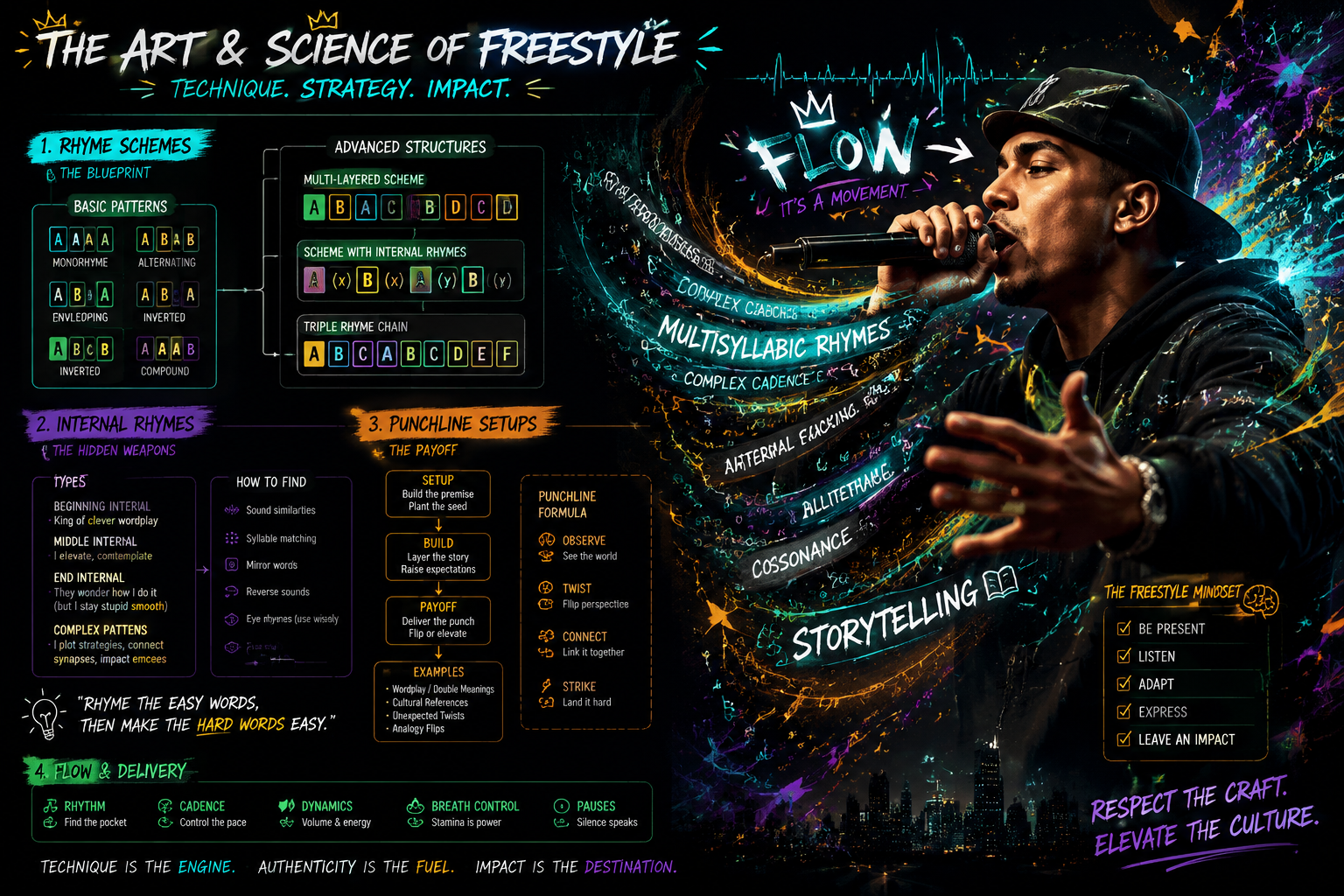
Focus on Internal Rhymes: Don't just rhyme the last word of a line. Try to rhyme words within your lines. This adds complexity and makes your flow smoother. For example, "My mind is kind of focused, I'm here to grind and toast it."
-
Build Your Word Bank: Dedicate time to learning new words and their rhymes. Use a resource like RhymeItNow.com/freestyle to quickly generate ideas and explore different rhyming options. Regularly review and internalize these.
-
Tell a Simple Story: Instead of just random lines, try to maintain a loose narrative or theme for a few bars. This gives your freestyle more structure and makes it easier for the audience to follow.
-
Practice Recovery: Everyone stumbles. When you do, don't freeze. Practice techniques to recover quickly, such as repeating a previous word or phrase, using an ad-lib, or changing the subject smoothly.
-
Confidence is Key: Even if you're nervous, project confidence. Stand tall, make eye contact, and rap with conviction. A confident delivery can elevate even average lyrics. If you lack confidence, people might not buy into your message.
-
Breathe: Proper breathing helps maintain your stamina and control your delivery. Take deliberate breaths between lines to keep your flow consistent.
For instance, when facing a blank, a beginner might look at a hat worn by an audience member and rap, "Yo, that hat is black, I'm on the track, never lookin' back, gonna launch an attack." While simple, it uses observation, maintains rhythm, and includes a basic rhyme scheme.
What Kind of Words and Rhymes Work Best in a Rap Battle?
In a rap battle, the most effective words and rhymes are those that are impactful, multisyllabic, and unexpected, combined with strong punchlines and disses. While simple rhymes establish rhythm, advanced freestylers leverage internal rhymes, slant rhymes, and complex wordplay to showcase their skill and verbally outmaneuver their opponent.
Types of Words and Rhymes to Master:
-
Multisyllabic Rhymes: These are rhymes where multiple syllables align, creating a more intricate and impressive sound. For example, "atrocious" with "ferocious," or "ridiculous" with "pick a bus." These demonstrate linguistic skill.
-
Internal Rhymes: Rhyming words within the same line or adjacent lines, not just at the end. This adds texture and musicality to your flow. Example: "I spit a quick wit, never quit the bit."
-
Slant Rhymes (Near Rhymes): Words that have similar but not identical sounds, offering more flexibility when you can't find a perfect rhyme. "Tension" and "dimension" or "world" and "swirl" are examples. They show creativity and an ability to make words fit.
-
Punchlines and Disparagement: Words chosen specifically to deliver a witty, biting, or humorous insult to your opponent. These are critical for winning battles. Think sharp, unexpected put-downs.
-
Action Verbs and Vivid Adjectives: Use strong, descriptive language to paint a picture and make your lines more engaging and memorable. Instead of "walked," use "stomped" or "glided."
-
Topical Words: Incorporate words that relate to the current environment, your opponent's appearance, or recent events. This makes your freestyle feel immediate and relevant.
-
Words with Multiple Meanings (Puns): Cleverly using homophones or words with double meanings can add layers of wit to your lines.
Example of Effective Rhyme Usage:
Instead of: "You're weak, you can't speak, you just peek."
Try: "Your whole approach is quite atrocious, lacking any focus or any true ferocious devotion. You're just a clown, posing for the camera's lens, without the talent, friend, your career ends." This example uses multisyllabic rhymes ("atrocious/ferocious"), internal rhymes ("lens/ends"), and a diss, demonstrating higher skill.
Tools like the AI rap generator at rhymeitnow.com/freestyle can quickly suggest complex rhymes, helping you build this mental muscle.
How Do You Come Up With Creative Lines on the Spot?
Generating creative lines on the spot requires a combination of observation, quick word association, and a flexible mental framework. The most effective method involves constantly scanning your environment, actively listening to your opponent, and allowing your mind to free-associate while maintaining rhythm and flow.
Techniques for Spontaneous Creativity:
-
Observe and Describe: Actively scan your surroundings for objects, people, or situations. Start describing what you see, and let those descriptions lead you to rhyming words. For example, if you see a red light, you might think of "bright," "night," "fight." This grounds your rap in reality.
-
Borrow and Flip Your Opponent's Lines: Listen closely to what your opponent says. You can take their words, phrases, or even their cadence and cleverly twist them back against them. This shows quick thinking and puts them on the defensive.
-
Use Story Prompts: If you find yourself stuck, mentally pick a simple, common scenario (e.g., getting ready in the morning, taking a walk) and freestyle a short narrative about it. This provides a mental anchor.
-
Practice Stream of Consciousness: Sometimes, just letting words flow, even nonsensical ones initially, can unlock a creative pathway. The goal isn't to be perfect, but to keep the verbal engine running.
-
Develop Theme-Based Hooks: Have a few general themes in mind (e.g., confidence, struggle, victory, money). If you get lost, you can pivot to one of these themes and build a few lines around it, like finding rhymes for "throne" or "gold."
-
Utilize Rhyme Schemes as a Structure: Knowing you need to rhyme with "control" can lead you to "soul," "goal," or "patrol," guiding your thought process. Focus on completing the rhyme, then making sense of the line.
-
Mental Inventory of Punchlines: Over time, develop a mental bank of versatile punchline structures or concepts that you can adapt to different situations. While you can't write full lines, having go-to frameworks can save you.
-
The "Yes, And" Principle: Borrowed from improv comedy, this means accepting whatever thought comes to mind and building on it, rather than rejecting it. Don't self-edit too much in the moment.
For example, if an opponent has a flashy jacket, you might start with: "That jacket's shiny, but your rhymes are tiny, your whole flow whiny, ain't nobody gonna sign ye." It takes an observation and immediately builds rhymes and a diss. The ability to pivot from "jacket" to "tiny" to "whiny" requires quick word association.
Are There Specific Techniques to Improve My Flow?
Improving your flow in a freestyle rap challenge primarily involves mastering rhythm, varying vocal delivery, and seamlessly connecting your words and phrases to the beat. Consistency and natural rhythm are paramount, meaning your words should land on the beat smoothly, even when speeding up or slowing down.
Techniques to Enhance Your Flow:
-
Practice with a Metronome: Regularly rap over a metronome to internalize different tempos and develop precise timing. This helps you hit the beat consistently.
-
Vary Your Cadence: Don't rap every line at the same speed or rhythm. Experiment with quick bursts followed by slower, more drawn-out lines. This adds dynamic interest to your flow.
-
Utilize Pauses and Breath Control: Strategic pauses can build anticipation or emphasize a point. Effective breath control ensures you don't run out of air mid-sentence, which can disrupt your flow.
-
Syllable-on-Beat Matching: Focus on landing key syllables directly on the drum kicks or snare hits. This creates a powerful, locked-in feel.
-
Listen to Diverse Music: Exposure to different genres, especially those with complex rhythms, can broaden your understanding of musicality and inform your rap flow.
-
Experiment with Phrasing: Try different ways of structuring sentences to fit the beat. Sometimes, shortening a phrase or extending a word can make all the difference to keep the flow smooth.
-
Storytelling Flow: When telling a narrative, let the story guide your pace. Important plot points might be delivered slower for emphasis, while transitional elements can be quicker.
-
Analyze Your Favorite Rappers: Listen to rappers with excellent flow and try to emulate their techniques. Pay attention to how they use their voice, their rhythm, and their breath. Break down what makes their flow appealing.
-
Energy and Delivery: Your vocal energy impacts flow. A monotone delivery can make even good rhymes sound stale. Infuse emotion and conviction into your voice to enhance the overall impact.
For instance, a beginner might have a very consistent, almost robotic, flow. An advanced freestyler will shift their pace, perhaps rapping rapidly for two bars and then slowing down for a deliberate punchline, using breath to create natural breaks and build tension. This dynamic variation keeps the audience engaged and highlights lyrical skill.
What Are Common Mistakes People Make When Freestyling?
Common mistakes in freestyling often stem from a lack of practice, an overemphasis on complexity too early, or succumbing to performance pressure. These errors can derail a performance, making it difficult for the audience to follow or for the rapper to recover.
Pitfalls to Avoid:
-
Going Off-Beat: This is arguably the biggest mistake. If you can't stay on rhythm, your rap loses its musicality and becomes difficult to listen to. Prioritize beat adherence over everything else.
-
Forcing Rhymes: Trying too hard to find a perfect rhyme can lead to awkward phrasing, nonsensical lines, or breaking your flow entirely. It's better to use a slant rhyme or a simpler word than to force a clunky, off-topic rhyme.
-
Lack of Cohesion/Subject Hopping: Jumping from one unrelated topic to another makes your freestyle hard to follow. While spontaneity is key, try to maintain a loose theme or narrative for at least a few bars.
-
Mumbling or Low Energy: A lack of clear enunciation or a low-energy delivery makes even brilliant lyrics fall flat. Project your voice and maintain enthusiasm.
-
Excessive Pauses ("Dead Air"): Long silences indicate you're stuck and can break the momentum. Learn to fill gaps with ad-libs, repeating phrases, or shifting to simpler observations.
-
Ignoring the Opponent/Audience: In a battle, not engaging your opponent or the crowd can make your performance seem disconnected. Interaction makes your freestyle dynamic and relevant.
-
Overly Complex Vocabulary (Without Purpose): While a strong vocabulary is good, using obscure words just to sound smart can alienate your audience if they don't understand your references or if it hinders your flow.
-
Repetitive Rhymes: Sticking to the same simple rhyme scheme (e.g., always AABB with common words like "street" and "beat") can quickly become predictable and boring. Push for variety.
-
Not Practicing Out Loud: Many beginners practice in their heads. Freestyling out loud helps develop breath control, enunciation, and the physical act of rapping.
-
Lack of Confidence: Hesitation, looking down, or a timid delivery undermines your message. Even if you're nervous, project an aura of self-assurance.
For instance, a common mistake is a beginner getting stuck on finding a rhyme for "orange," then pausing for several seconds, completely losing the beat and momentum. A better approach would be to shift to "door hinge" as a slant rhyme or pivot to another word like "bright" to keep the flow going.
How Do You Deal with Stage Fright During a Challenge?
Dealing with stage fright during a freestyle rap challenge involves a combination of mental preparation, physical techniques, and reframing your perspective on performance anxiety. The key is to transform nervous energy into focused excitement rather than letting it paralyze your delivery.
Strategies for Managing Stage Fright:
-
Preparation Builds Confidence: The more you practice, the more confident you'll feel. Familiarity with beats, words, and recovery techniques reduces the unknown, which is a major source of anxiety.
-
Deep Breathing Exercises: Before stepping on stage, take slow, deep breaths. Inhale deeply through your nose, hold for a few seconds, and exhale slowly through your mouth. This calms your nervous system.
-
Positive Visualization: Imagine yourself performing successfully, delivering strong lines, and captivating the crowd. Visualizing positive outcomes can reduce fear and build self-assurance.
-
Acknowledge and Reframe Nerves: Recognize that the butterflies in your stomach are simply adrenaline. Instead of interpreting it as fear, tell yourself it's excitement and readiness to perform.
-
Focus on the Beat: When you start, narrow your focus purely on the instrumental beat. Locking into the rhythm can help shift your attention away from the audience and your anxiety.
-
Start with Familiar Lines/Ad-Libs: If you have go-to opening lines or ad-libs that you feel comfortable with, use them to get started. This can create initial momentum and ease you into the performance.
-
Make Eye Contact (Strategically): Instead of staring at the entire crowd, pick a few friendly faces or even points in the room to look at. This creates connection without feeling overwhelmed by a sea of eyes.
-
Move Your Body: Physical movement, even subtle head nods or hand gestures, can help release nervous energy and make your performance more dynamic.
-
Hydrate: A dry mouth can worsen performance anxiety. Keep water handy and take sips if needed.
-
Embrace the Imperfection: Understand that nobody expects perfection in a freestyle. The audience appreciates authenticity and effort. Give yourself permission to make mistakes and recover.
For example, a common technique for managing pre-performance jitters is to do a quick vocal warm-up backstage and visualize the crowd cheering for a particularly strong punchline. This primes the mind and body for a successful performance, leveraging the adrenaline for energy rather than letting it become fear.
What's the Difference Between a Freestyle and a Written Rap?
The fundamental difference between a freestyle and a written rap lies in their spontaneity and preparation. A freestyle rap is entirely improvised on the spot, with lyrics created in real-time without any prior writing or memorization, whereas a written rap features pre-composed lyrics that have been meticulously crafted, rehearsed, and often recorded in a studio.
Key Distinctions:
FeatureFreestyle RapWritten RapPreparationNone; lyrics are fully improvised in the moment.Extensive; lyrics are written, revised, and memorized.SpontaneityHigh; relies on quick thinking and adaptability.Low; execution is pre-planned and rehearsed.Lyrical FocusWit, immediate response, observation, word association.Storytelling, complex metaphors, multi-layered themes, intricate structure.DeliveryOften raw, energetic, can have minor stumbles.Polished, precise, consistent, fewer errors.Rhyme SchemeCan be simpler, relies on internal & slant rhymes for complexity.Highly intricate, often uses multisyllabic, dense rhyme patterns.ContextRap battles, cyphers, open mics, impromptu performances.Studio recordings, albums, music videos, concerts.ChallengeMental agility, quick recovery, staying on beat.Crafting compelling narratives, lyrical depth, perfect flow.
A rapper might spend weeks perfecting a written verse, ensuring every syllable, every rhyme, and every punchline is exactly as intended for a song. In contrast, a freestyler's genius is in their ability to invent compelling narratives and disses in the immediate moment, making mistakes a part of the art form and recoveries a testament to their skill.
Where Can I Find Local Rap Battles or Open Mics?
Finding local rap battles or open mics typically involves tapping into local music communities, using online search engines, and networking within the hip-hop scene. These venues offer crucial opportunities for aspiring freestylers to practice, gain experience, and build a reputation.
Ways to Discover Local Opportunities:
-
Online Event Listings: Check websites like Eventbrite, Meetup, or local arts and culture calendars for "open mic nights," "rap battles," or "hip-hop events" in your city.
-
Social Media Groups: Join local Facebook groups or subreddits dedicated to hip-hop, poetry, or music in your area. People often share event information there.
-
Local Music Venues: Many bars, cafes, and small music clubs host regular open mic nights. Call them directly or check their websites. Even if they're not rap-specific, they can be a good starting point.
-
Record Stores and Music Shops: These places often have bulletin boards with flyers for local events or staff who are knowledgeable about the local music scene.
-
University and College Campuses: Student organizations often host open mics or poetry slams that welcome rappers. Check their events calendars.
-
Network at Shows: Attend local hip-hop concerts, even if they aren't battles. Talk to artists and audience members; they're often the best source for discovering underground events.
-
Ask Experienced Rappers: If you know local rappers or producers, ask them where they got their start or where they recommend beginners go.
For example, a quick search on Facebook for "Chicago open mic rap" or checking the event schedule of a popular local venue like "The Empty Bottle" in Chicago might reveal upcoming freestyle opportunities.
Are There Online Resources or Communities for Aspiring Freestylers?
Yes, a wealth of online resources and communities exist for aspiring freestylers, offering tools for practice, platforms for sharing, and forums for networking. These digital spaces are invaluable for honing skills, finding inspiration, and connecting with a global community of like-minded artists.
Key Online Resources:
-
AI Rhyme Generators: Websites like RhymeItNow.com offer sophisticated AI-powered rhyme finders that can generate a multitude of rhyming words, including slant and multisyllabic options, for any given word. RhymeItNow.com/freestyle even features an AI rap generator tool to help with creative block.
-
YouTube Tutorials and Battles: Countless YouTube channels offer tutorials on freestyle techniques, flow, and delivery. Watching recorded rap battles provides insight into different styles and strategies.
-
Online Rap Forums and Subreddits: Communities like r/freestyle on Reddit or various hip-hop forums provide platforms for sharing freestyles, getting feedback, and discussing techniques.
-
Discord Servers: Many hip-hop and rap-focused Discord servers host virtual cyphers where members can practice freestyling together over voice chat.
-
Beat Websites/Apps: Platforms like YouTube, SoundCloud, or dedicated beat-making apps offer an endless supply of instrumental beats to practice over, often categorized by genre or tempo.
-
Online Cypher Platforms: Some websites or apps are specifically designed for online rap cyphers, allowing users to take turns freestyling over a shared beat.
-
Lyric Websites: Websites that analyze and break down rap lyrics can offer insights into complex rhyme schemes and wordplay used by professional rappers.
For instance, a beginner struggling with finding rhymes for "truth" might use RhymeItNow.com to quickly generate options like "youth," "booth," "uncouth," or "proof," then incorporate these into their practice. The AI rap generator on rhymeitnow.com/freestyle can also provide a starting point or help overcome creative blocks.
What Kind of Person Is Good at Freestyle Rapping?
A person who is good at freestyle rapping typically possesses a unique blend of creativity, quick wit, a broad vocabulary, and exceptional mental agility. These individuals are often keen observers, natural storytellers, and highly adaptable verbal communicators, capable of processing information and responding articulately in real-time.
Traits of a Skilled Freestyler:
-
Quick-Witted and Mentally Agile: The ability to think on your feet, process information rapidly, and form coherent thoughts under pressure is crucial.
-
Extensive Vocabulary: A rich lexicon provides more rhyming options and allows for more nuanced and sophisticated lyrical content.
-
Strong Sense of Rhythm: An innate understanding of timing and beat, allowing them to stay on flow effortlessly.
-
Observant: The capacity to quickly notice details in their surroundings, about their opponent, or within the crowd, and integrate these into their rap.
-
Creative and Imaginative: The skill to weave compelling narratives, metaphors, and punchlines spontaneously.
-
Confident and Charismatic: A strong stage presence, clear delivery, and the ability to command attention are vital for impact.
-
Resilient and Adaptable: The capacity to recover quickly from mistakes, pivot subjects, and adjust to unexpected challenges during a battle.
-
Emotionally Intelligent: In battles, understanding and manipulating emotions, both their own and their opponent's, can be a powerful tool.
-
Well-Read/Knowledgeable: A broad understanding of current events, pop culture, and various subjects can provide a deep well of content for diverse freestyles.
-
Disciplined Practicer: While freestyle is spontaneous, the underlying skill comes from consistent practice and dedication to the craft.
For example, a skilled freestyler might notice their opponent's unusual shoes and immediately craft a multi-syllabic rhyme about their "questionable footwear" being "unbearable to wear," demonstrating observation, quick wit, and a broad vocabulary.
What Are Some Advanced Tips for Experienced Freestylers?
Experienced freestylers seeking to elevate their game should focus on refining complex lyrical structures, perfecting their stage presence, and developing sophisticated battle strategies. Moving beyond basic rhymes, advanced techniques involve intricate wordplay, layered storytelling, and a deep understanding of audience psychology.
Advanced Strategies for Mastery:
-
Master Complex Rhyme Schemes: Move beyond simple AABB. Experiment with AABBCB, internal rhymes that span multiple lines, and intricate multisyllabic patterns. Aim for unexpected rhyme placements that still sound natural.
-
Layered Punchlines: Craft punchlines that have multiple meanings or build on previous statements. A single line can deliver a direct diss, a clever metaphor, and a call-back all at once.
-
Thematic Cohesion and Storytelling: Maintain a strong, evolving theme throughout your rounds. Weave a continuous narrative or argument against your opponent, making your freestyle feel like a cohesive, well-structured piece.
-
Vocal Dynamics and Delivery: Utilize your voice as an instrument. Experiment with different tones, volumes, and speeds to create dramatic effect, emphasize points, and maintain listener engagement. This includes knowing when to slow down for impact and when to speed up for intensity.
-
Crowd Manipulation and Interaction: Learn to read the crowd and respond to their energy. Use call-and-response, direct questions, or even subtle gestures to get them on your side and turn them against your opponent.
-
Battle Strategy and Counter-Punching: Plan your attacks. Identify your opponent's weaknesses (lyrical, visual, performance) and craft specific disses. Be ready to quickly counter any attacks they launch against you.
-
Metaphor and Analogy Mastery: Elevate your descriptive language by using fresh, impactful metaphors and analogies. Avoid clichés and strive for original comparisons that make your lines more vivid and memorable.
-
Controlled Aggression: In a battle, deliver your disses with conviction and aggression, but remain in control. Losing your temper can hinder your flow and focus.
-
Self-Referential Humor and Vulnerability (Strategic): Sometimes, acknowledging your own minor stumbles with humor, or showing a brief moment of vulnerability, can make you more relatable and endearing to the audience, earning their support.
-
The Unexpected Turn: Learn to set up an expectation in the audience's mind and then pivot unexpectedly, delivering a surprise punchline or a twist in your narrative. This showcases extreme wit.
For instance, an advanced freestyler might not just insult an opponent's clothes but weave a complex narrative about the source of their clothes, implying poverty or a lack of originality, then conclude with a double-meaning punchline that draws a clever parallel to another well-known figure, engaging the audience's intellect and humor simultaneously.
How Do Judges Typically Score Freestyle Rap Battles?
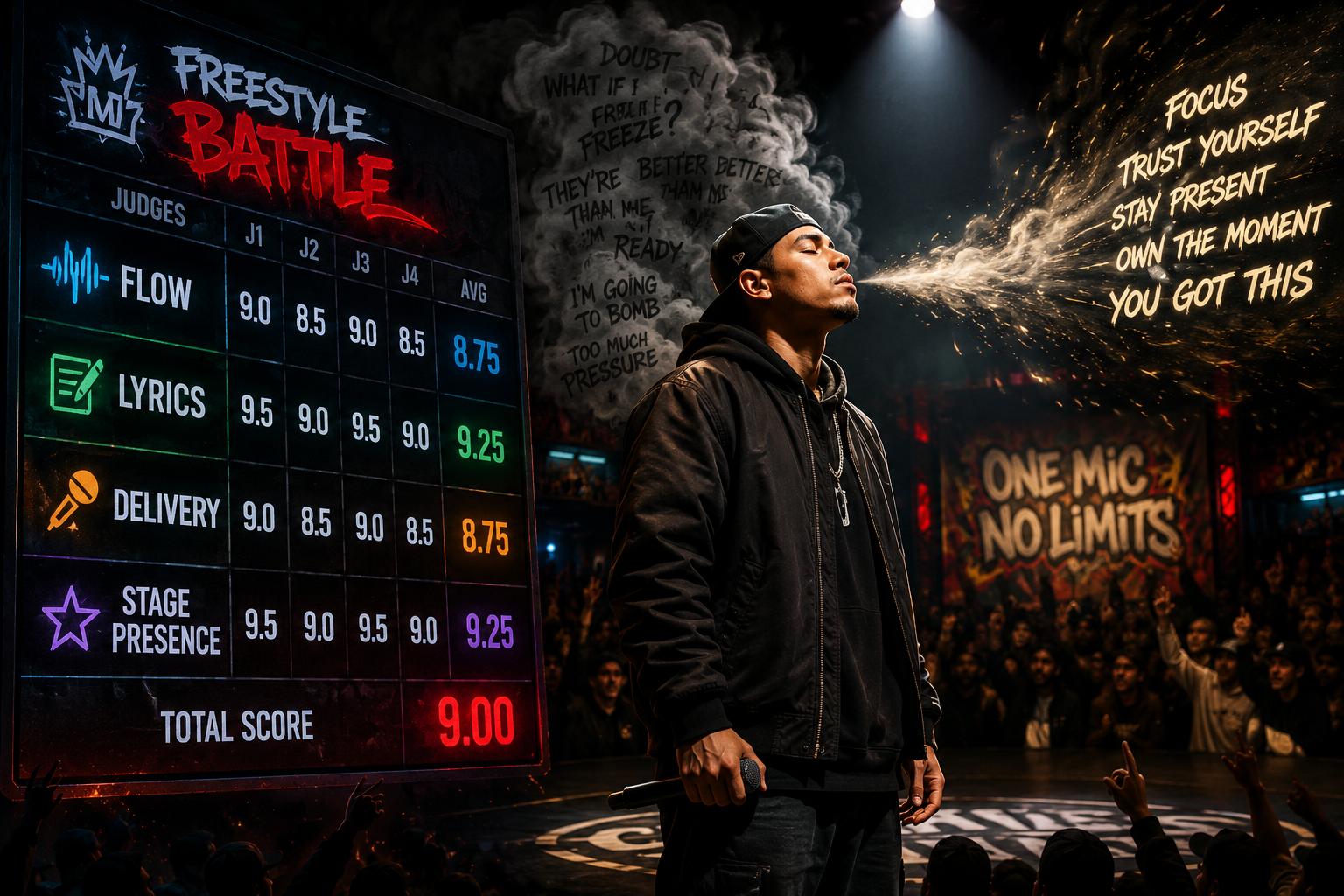
Judges typically score freestyle rap battles based on a weighted combination of several key criteria, with Flow, Lyrical Content, Delivery, and Stage Presence being the most common and critical elements. While exact scoring systems vary, the underlying goal is to assess the rapper's overall skill in spontaneous lyrical creation and performance.
Common Scoring Criteria:
-
Flow (Rhythm & Cadence):
-
Definition: How well the rapper stays on beat, maintains rhythm, and varies their cadence.
-
What Judges Look For: Consistency, musicality, ability to ride the beat creatively, and dynamic changes in speed and rhythm. A smooth, engaging flow earns high marks.
-
-
Lyrical Content (Words & Rhymes):
-
Definition: The quality, originality, and complexity of the words and rhyme schemes.
-
What Judges Look For:
-
Rhyme Complexity: Use of multisyllabic, internal, and slant rhymes.
-
Wordplay: Puns, metaphors, analogies, and clever turns of phrase.
-
Creativity & Originality: Unique lines, unexpected angles, avoiding clichés.
-
Relevance: How well the lyrics address the opponent or current environment.
-
Punchlines: The impact, wit, and effectiveness of disses.
-
-
-
Delivery (Voice & Enunciation):
-
Definition: How clearly and powerfully the lyrics are articulated, and the emotional impact of the performance.
-
What Judges Look For: Clear enunciation, vocal projection, confidence, passion, and effective use of voice to convey emotion or emphasize points. Mumbling or low energy scores poorly.
-
-
Stage Presence (Engagement & Charisma):
-
Definition: The rapper's command of the stage, audience interaction, and overall charisma.
-
What Judges Look For: Eye contact, body language, crowd engagement (call-and-response), confidence, and an engaging persona. A captivating performer often wins over a technically superior but less engaging rapper.
-
-
Rebuttals/Responsiveness (in Battle Format):
-
Definition: The ability to directly respond to an opponent's lines and turn their attacks back on them.
-
What Judges Look For: Quick wit, direct address of opponent's specific lines, and clever counter-attacks. This demonstrates true freestyle ability.
-
Judges often weigh these categories differently. For example, in a raw street battle, punchlines and aggression might be prioritized, while in a more artistic poetry slam, lyrical depth and storytelling might score higher. However, consistently strong performance across all categories is the surest path to victory in any freestyle rap challenge.
Conclusion
Winning a freestyle rap challenge is a testament to raw talent honed by diligent practice and strategic thinking. It demands more than just rhyming; it calls for a mastery of flow, quick-witted observation, powerful delivery, and genuine engagement. While the journey from novice to master requires dedication, the thrill of spontaneous creation and connection with an audience is an unparalleled reward.
Whether you're taking your first steps into the world of improvised lyrics or an experienced wordsmith looking to refine your craft, remember that consistency is your greatest ally. Regularly practicing word association, actively listening to beats, and continuously expanding your vocabulary will build the foundational skills you need. Don't shy away from using modern tools like AI rhyme generators and rap generators, which can significantly accelerate your learning and creative process. Head over to rhymeitnow.com/freestyle to explore these resources and start sharpening your skills today. Embrace the challenge, learn from every stumble, and let your unique voice shine through in every spontaneous line you deliver.
FAQ
Q: Is beatboxing considered part of freestyle rap?
A: While beatboxing can accompany freestyle rap and showcase vocal rhythm, it is a distinct art form. Freestyle rap focuses specifically on improvised lyrical content over a beat, which can be provided by a DJ, a pre-recorded instrumental, or a beatboxer.
Q: How long should a typical freestyle rap battle round be?
A: A typical freestyle rap battle round can vary from 30 seconds to 2 minutes per rapper, depending on the event's format and rules. Some battles have multiple rounds, with increasing time limits or specific themes.
Q: Can I use pre-written lines in a freestyle rap challenge?
A: No, using pre-written lines is strictly against the spirit and rules of a true freestyle rap challenge. The core definition of freestyle is improvisation; using memorized lines is often considered cheating and can lead to disqualification.
Q: What if I forget my words or stumble during a freestyle?
A: Forgetting words or stumbling is common in freestyle. The best approach is to recover smoothly by repeating a previous word or phrase, using an ad-lib (e.g., "uh-huh," "yeah"), or pivoting to a new subject while staying on beat. Confidence in recovery is key.
Q: How important is punchline delivery in a rap battle?
A: Punchline delivery is extremely important in a rap battle. A well-delivered, witty punchline can sway judges and the crowd, earning significant points and potentially demoralizing your opponent. It's often the climax of a round.
Q: Should I insult my opponent in a freestyle rap battle?
A: Yes, in a battle format, "dissing" your opponent (lighthearted insults and verbal attacks) is a core component. The goal is to outwit and out-rap them, not necessarily to cause genuine offense, though the lines can sometimes blur depending on the battle culture.
Q: How do I find instrumentals to practice freestyle rapping?
A: You can find instrumental beats for practice on YouTube (search "hip hop instrumental," "rap beats"), SoundCloud, dedicated beat-making websites, or by using music production software. Look for a clear tempo and a rhythm you enjoy.
Q: Does practicing with a rhyme dictionary help with freestyling?
A: Yes, regularly using a rhyme dictionary or AI rhyme finder like RhymeItNow.com significantly expands your mental database of rhyming words and concepts, which is crucial for quick, spontaneous rhyming during a freestyle.
Q: Is it okay to use simple rhymes if I'm a beginner?
A: Absolutely. As a beginner, focusing on staying on beat and delivering coherent thoughts with simple rhymes is more effective than struggling with complex rhymes and losing your flow. Complexity will come with practice.
Q: What is a "cypher" in freestyle rap?
A: A cypher is a circle of rappers, often accompanied by a beat, where participants take turns freestyling, passing the microphone from one to another. It's a common, informal setting for practicing and showcasing freestyle skills.
Q: How can I make my voice sound better when freestyling?
A: Improve your voice by practicing vocal warm-ups, focusing on clear enunciation, projecting your voice from your diaphragm, and varying your tone and volume. Hydration and proper breathing also contribute to better vocal performance.
Q: Do I need to know music theory to freestyle rap?
A: No, you do not need to know music theory to freestyle rap. A natural ear for rhythm and beat is more important. While understanding musical structure can be an advantage, many successful freestylers learn purely by feel and practice.
Q: Can humor be effective in a freestyle rap challenge?
A: Yes, humor can be incredibly effective. Clever, witty, and well-timed jokes or self-deprecating humor can endear you to the crowd and often hit harder than aggressive disses, making your performance more memorable.
Q: What's the role of the crowd in a freestyle rap battle?
A: The crowd plays a crucial role. Their reactions (cheers, boos, laughter) often influence judges' decisions, especially in subjective scoring categories like "Stage Presence" and "Impact." Engaging the crowd is a key battle tactic.
Q: How important is confidence in winning a freestyle rap challenge?
A: Confidence is paramount. A confident delivery can make even average lyrics sound better, while a lack of confidence can undermine strong lyrical content. It projects authority and captivates the audience and judges.
Q: What's the best way to get feedback on my freestyle skills?
A: The best way to get feedback is to record yourself and listen back, or to perform at open mics and ask trusted friends, mentors, or fellow rappers for honest critiques. Online communities can also provide constructive feedback.
Q: How can I expand my vocabulary for freestyling?
A: Expand your vocabulary by reading books, articles, and song lyrics regularly. Keep a journal of new words and their rhymes, and actively use tools like RhymeItNow.com to explore rhyming options and build your word bank.
Q: Are there different styles of freestyle rap?
A: Yes, there are many styles, including aggressive battle rap, humorous rap, storytelling freestyle, abstract/complex lyrical rap, and more melodic, rhythmic styles. Each emphasizes different aspects of lyrical and performance skill.
Q: What if the beat changes during a freestyle rap challenge?
A: If the beat changes, an experienced freestyler adapts quickly. They will often pause briefly to catch the new rhythm or seamlessly transition their flow to match the new tempo and feel. Adaptability is a sign of skill.
Q: How can I practice storytelling in my freestyles?
A: Practice storytelling by mentally choosing a simple prompt (e.g., "a trip to the grocery store") and trying to narrate it over a beat. Focus on developing a beginning, middle, and end, even if it's brief, to build narrative flow.
Q: Is it better to focus on complex rhymes or coherent lines?
A: It's better to focus on coherent lines that make sense and follow a logical thought, even if the rhymes are simpler. Forcing complex rhymes that lead to nonsensical or disjointed lines will detract from your performance more than simple, clear rhymes.
Q: What's the purpose of an AI rap generator like the one on RhymeItNow.com?
A: An AI rap generator is designed to help artists overcome writer's block, generate creative ideas, experiment with different styles, or simply get a quick start with lines and rhyme schemes for practice. It serves as a creative assistant for spontaneous lyrical creation.
Q: Should I rap fast or slow in a freestyle battle?
A: The best approach is to vary your speed. Rapping fast can showcase technical skill and energy, while slowing down can emphasize punchlines or dramatic moments. Monotony in speed can make your flow predictable.
Q: How do I build confidence as a beginner freestyler?
A: Build confidence by consistent practice in private, performing for a small, supportive audience, setting achievable goals, and celebrating small victories. Focus on incremental improvement rather than instant perfection.
Q: Can I freestyle without a beat?
A: Yes, you can freestyle a cappella (without a beat). This tests pure lyrical skill and rhythm, as you must provide all the rhythmic structure yourself. However, most formal challenges involve a beat.
Q: What are the best ways to get inspired for a freestyle?
A: Get inspired by observing your surroundings, listening to current conversations, interacting with the crowd, or drawing from your own experiences and emotions. The most immediate inspiration often comes from the present moment.
Q: Is it okay to reuse certain phrases or setups in different freestyles?
A: While true freestyle is spontaneous, having a few go-to ad-libs, transitional phrases, or even general concepts you're comfortable rapping about can help fill gaps or start strong. However, avoid reusing full, identical lines.
Q: How can I make my freestyle more original?
A: Make your freestyle more original by drawing from unique personal experiences, using fresh metaphors, avoiding common rap clichés, and developing a distinctive vocal style and persona that sets you apart from others.
Q: What is "word association" in freestyle rap?
A: Word association is the mental process of quickly linking one word to another based on sound, meaning, or concept. It's fundamental to freestyle, allowing rappers to rapidly generate follow-up lines and rhymes.
Q: Are freestyle rap challenges inclusive of different languages?
A: While English is dominant in many mainstream rap battles, freestyle rap challenges exist in numerous languages globally. The principles of improvisation, rhythm, and wordplay are universal across linguistic barriers.
Q: How can I stay calm under pressure in a rap battle?
A: Stay calm by practicing deep breathing, visualizing success, focusing intensely on the beat, and reminding yourself that it's a performance and a chance to express yourself. Experience also builds resilience under pressure.
Q: What's the difference between a "diss" and a genuine insult in a battle?
A: A "diss" in a battle is a verbal attack or insult meant to be part of the competition, usually accepted as sport. A genuine insult, however, crosses the line into personal attacks that are considered disrespectful and are generally frowned upon in the culture.
Q: How do I improve my internal rhymes?
A: Improve internal rhymes by consciously practicing them during your freestyle sessions. Focus on finding words within a line that rhyme with each other or with a word at the beginning of the next line, rather than just the end-of-line rhymes.
Q: What's the benefit of recording my freestyle practice sessions?
A: Recording yourself allows you to objectively review your performance. You can identify areas where your flow was weak, rhymes were forced, or content was unclear, providing concrete points for improvement.
Q: Should I try to rap about deep topics or keep it light?
A: Your choice depends on your style and the battle context. While humor and lighthearted disses are common, tackling deeper topics with skill can also be very impactful, showcasing lyrical depth and intellectual prowess.
Q: How important is body language in a freestyle rap challenge?
A: Body language is very important. Confident posture, hand gestures, and eye contact enhance your delivery and stage presence, making you appear more authoritative and engaging, which positively influences judges and the crowd.
Q: Can freestyle rap help improve my public speaking skills?
A: Absolutely. Freestyle rap significantly enhances public speaking by improving quick thinking, verbal fluency, confidence, stage presence, and the ability to articulate thoughts under pressure, all vital for effective communication.
Q: What's the best advice for someone about to enter their first freestyle rap challenge?
A: For your first challenge, focus on three things: stay on beat, project your voice, and have fun. Don't worry about being perfect. Embrace the experience, learn, and use it as a stepping stone for future growth.
Related Reading
Find the perfect rhyme for your next song
Try RhymeItNow →